
Summary of SPARKFUN’S USB TYPE-C 5-20V 5A POWER DELIVERY BOARD FEATURES QWIIC CONNECTOR
SparkFun’s Power Delivery Board uses the STMicroelectronics STUSB4500 USB‑PD controller to negotiate adjustable USB‑C power (5–20V, up to 5A per profile, up to 100W). It provides three user‑configurable PD profiles, stores settings in controller NVM, includes VBUS monitoring and PMOS drivers, is USB Type‑C Rev.1.2 / USB PD Rev.2.0 certified, and offers solderable headers plus a 3.3V Qwiic connector for easy I2C configuration from a microcontroller.
Parts used in the SparkFun Power Delivery Board:
- STMicroelectronics STUSB4500 USB Power Delivery controller
- USB Type-C connector (full USB Type-C Rev. 1.2 compliant)
- PMOS switch gate drivers
- VBUS voltage monitoring circuitry
- Solderable pin headers
- 3.3V Qwiic connector (I2C)
- Plated through holes for SDA and SCL
- Non-volatile memory within STUSB4500 for storing NVM parameters
USB Type-C introduced significant changes to the USB standard. The reversible connector eliminated the issue of trying to plug the connector in the right way every time. Another issue it addressed was allowing the flexibility to have USB power with an adjustable USB voltage from anywhere between 5V and 20V and up to 100W of power. The SparkFun Power Delivery Board takes advantage of the power delivery standard with the use of a standalone controller from STMicroelectronics, the STUSB4500.
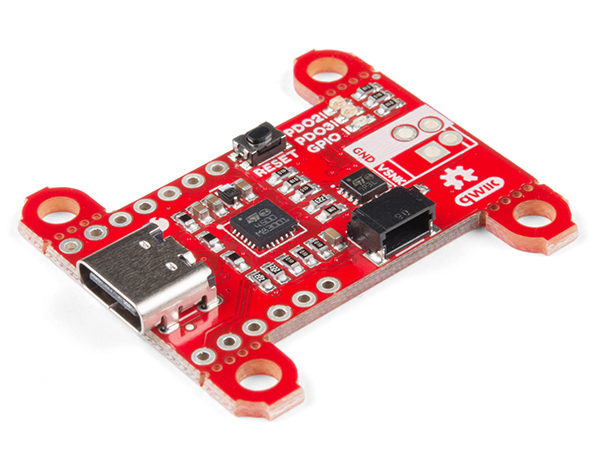
SparkFun has now introduced a new method for powering your projects. This is possible through the flexibility of the USB Power Delivery Standard, which is a standalone USB Type-C power board with three configurable power delivery profiles.
Xtopher from SparkFun says
Traditional power adapters can provide a wide range of current but the voltage stays fixed at 5V.” The company say “With the SparkFun Power Delivery Board’s USB-C connection it has the ability to achieve higher voltages, typically 5-20V and up to 100W of power. The Power Delivery Board uses a standalone controller to negotiate with the power adapters and have them switch to a higher voltage other than just 5V. This uses the same power adapter for different projects rather than relying on multiple power adapters to provide different output voltages.
SparkFun Power Delivery Board is based on an STMicroelectronics STUSB4500 USB Power Delivery controller, which enables the negotiation of power delivery without an external microcontroller. However, SparkFun states that a microcontroller is still required for configuration, with the settings being stored in a non-volatile storage space on the controller itself. The controller board consists of input and output voltage ranges of 5-20V, with output current clocking up to 5A across three user-configurable power delivery profiles. It has a full USB Type-C Rev. 1.2 and USB Power Delivery Rev. 2.0 certification, and enables integrated VBUS voltage monitoring and PMOS switch gate drivers. Apart from its solderable pin headers, available also is a singular 3.3V Qwiic connector for solder-free connection into SparkFun‘s quick-connect I2C ecosystem. To configure the board, you will need the I2C bus. The Qwiic system makes it easy to connect the Power Delivery board to a microcontroller to set the NVM parameters to power your project via the Qwiic connector. Depending on your application, you can also connect to the I2C bus via the plated through holes for SDA and SCL.
Read more: SPARKFUN’S USB TYPE-C 5-20V 5A POWER DELIVERY BOARD FEATURES QWIIC CONNECTOR
- What voltage range does the SparkFun Power Delivery Board support?
The board supports an input and output voltage range of 5 to 20V. - How much current can the Power Delivery Board provide?
The board can provide output current up to 5A across its profiles. - How many power delivery profiles are configurable on the board?
The board offers three user-configurable power delivery profiles. - Does the board require a microcontroller to configure power settings?
Yes, a microcontroller is required to configure the board, with settings stored in the controller's non-volatile storage. - Which controller does the SparkFun Power Delivery Board use?
It uses the STMicroelectronics STUSB4500 USB Power Delivery controller. - Is the board certified for USB standards?
Yes, it is certified for USB Type-C Rev. 1.2 and USB Power Delivery Rev. 2.0. - How do you configure the board via I2C without soldering?
You can use the 3.3V Qwiic connector to connect to a microcontroller for configuration via I2C. - Can you access the I2C bus without using the Qwiic connector?
Yes, you can connect to the I2C bus via the plated through holes for SDA and SCL. - What advantage does USB Power Delivery provide over traditional 5V adapters?
USB Power Delivery lets adapters supply higher voltages, typically 5 to 20V, allowing one adapter to power multiple projects instead of needing multiple fixed-voltage adapters.
