
Summary of HLK-7688A OPENWRT DEVELOPMENT BOARD COMES WITH AN AUDIO JACK
This article introduces a new OpenWrt audio board featuring the Hi-Link HLK-7688A module. Designed as a video or audio streamer, it supports file playback from USB or MicroSD storage for multiple phones. The hardware includes a MediaTek MT7688 processor, 32MB RAM, and a WM8960 audio codec. However, the text highlights significant software challenges, noting that while OpenWrt runs on the device, driver support remains limited to version 15 with numerous bugs. Specifically, users report that I2S functionality is currently impossible, preventing audio output despite successful USB audio testing with LinkIt firmware.
Parts used in the HLK-7688A Audio Board:
- HLK-7688A Module
- MediaTek MT7688 MIPS24KEc Processor
- 32MB RAM
- 128MB Flash Storage
- MicroSD Card Slot
- u.FL Antenna Connector
- 3.5mm Audio Jack
- 4-pin Speaker Header
- WM8960 Audio Codec
- 2x Micro USB Ports
- 2x 26-pin Headers
- 4x Status LEDs
- Reset Button
- Factory Reset Button
Another OpenWrt audio board based on the processor with HLK-7688A board featuring Hi-Link HLK-7688A module is launched.
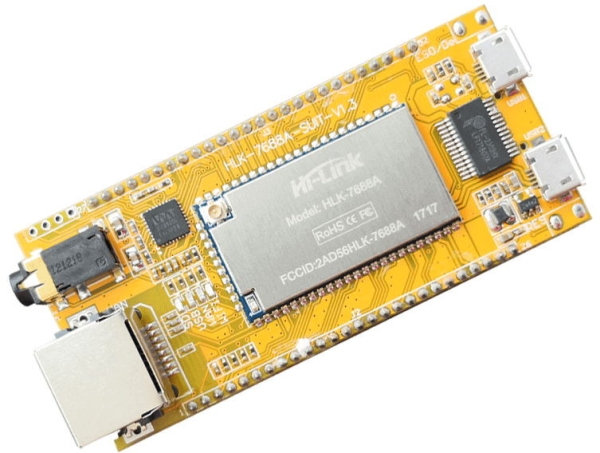
HLK-7688A board specifications:
- Wireless Module – HLK-7688A based on MediaTek MT7688 MIPS24KEc processor @ 580 MHz, and equipped with 32MB RAM, 128MB flash
- Storage – MicroSD card slot
- Connectivity
- 802.11 b/g/n WiFi 4 up to 150 Mbps with u.FL antenna connector
- 10/100M Ethernet
- Audio – 3.5mm audio jack; 4-pin speaker header, WM8960 audio codec
- USB – 2x Micro USB ports one USB 2.0 port and one for debugging & power
- Expansion – 2x 26-pin headers with GPIO’s, SPI, UART, I2C, I2S, Ethernet, USB, GND, 3.3V…
- Misc – 4x status LED’s for WiFi, LAN, USB, and WiFi; reset button, factory reset button (long press)
- Power Supply – 5V via Micro USB port
- Dimensions – Module: 32.8 x 18 mm; Board (est): 75 x 34 mm
The board is apparently sold as a video and/or audio streamer storing files in USB storage or MicroSD card to be played on your phone. Up to 8 phones are supported for photo sharing, and 3 phones for simultaneous video streaming.
One of the photos of the board shows it supports OpenWrt 3.10 with Linux 2.6.36 SDK. It’s probably a mistake, as when I tested the MediaTek LinkIt board two years ago, it ran Linux 3.18.21, OpenWrt Chaos Calmet 15.05+.
One buyer also mentions USB audio works just fine with Linkit firmware, and the latest version of OpenWrt can run on the board but without I2S nor I2C support. He later updated his comment with further details:
Openwrt driver support is left at v15 and even this version 15 is full of bugs. I2S is “mission impossible” andI could not get sound out of that board
Read more: HLK-7688A OPENWRT DEVELOPMENT BOARD COMES WITH AN AUDIO JACK
- What is the primary function of this board?
The board is sold as a video and/or audio streamer that stores files in USB storage or MicroSD card for playback on phones. - How many phones can connect simultaneously for streaming?
Up to 8 phones are supported for photo sharing, and 3 phones for simultaneous video streaming. - Does the board support I2S functionality in OpenWrt?
No, user reports indicate that I2S is considered mission impossible and sound cannot be obtained via that method. - Can USB audio work on this board?
Yes, one buyer mentioned that USB audio works just fine with LinkIt firmware. - Which OpenWrt version has the most driver support available?
OpenWrt driver support is currently left at version 15, although this version is described as full of bugs. - What Linux kernel version was initially shown on the board photos?
One photo shows the board supporting OpenWrt 3.10 with Linux 2.6.36 SDK, though this is likely a mistake. - Is there an Ethernet port on the board?
Yes, the board features 10/100M Ethernet connectivity alongside WiFi. - What type of expansion headers does the board provide?
The board includes 2x 26-pin headers offering GPIOs, SPI, UART, I2C, I2S, Ethernet, USB, GND, and 3.3V pins.
