
Summary of ALL BAND RADIO USES ARDUINO AND SI4730
This article highlights Mirko's impressive all-band radio project, which blends commercial-grade performance with a homemade aesthetic. The build utilizes the Si4730 chip for superior reception across AM, FM, and shortwave bands, featuring built-in DSP and RDS decoding. Controlled via an Arduino, the system accepts serial commands to manage a user-friendly interface. Despite the 4730 chip lacking native shortwave support in some configurations, it successfully operates using libraries designed for the 4735 model, demonstrating the flexibility of modern radio ICs in DIY electronics.
Parts used in the All Band Radio:
- Si4730 radio chip
- Arduino microcontroller
- User interface components
- All band radio case
- Si4735 library (software)
It is getting harder and harder to tell homemade projects from commercial ones. A good case in point is [Mirko’s] all band radio which you can see in the video below the break. On the outside, it has a good looking case. On the inside, it uses a Si4730 radio which has excellent performance that would be hard to get with discrete components.
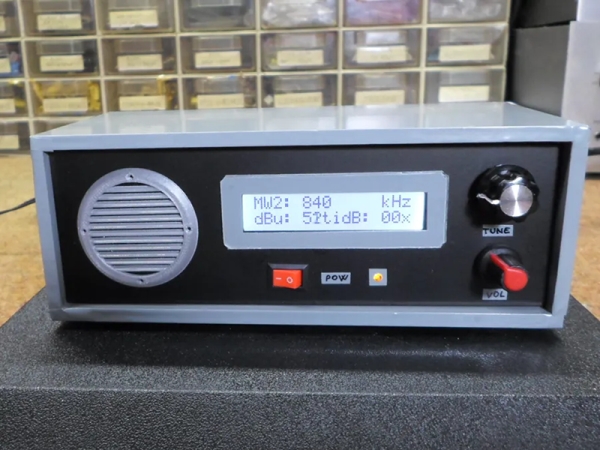
The chip contains two RF strips with AGC, built-in converters to go from analog to digital and back and also has a DSP onboard. The chip will do FM 64 to 108 MHz and can demodulate AM signals ranging from 153 kHz to 279 kHz, 520 kHz to 1.71 MHz, and 2.3 MHz to 26.1 MHz. It can even read RDS and RBDS for station information. The output can be digital (in several formats) or analog.
The radio takes serial (I2C) commands, and the Arduino converts the user interface so that you can control it. The chip comes in several flavors, each with slightly different features. For example, the Si4731 and Si4735 have the RDS/RBDS decoder, and the shortwave mode is available on Si4734 and Si4735. Confused? Page 2 of the programming guide should help. According to [Mirko], he used a 4730, but it still did shortwave with the 4735 library.
Breakout boards with the chip are just a few bucks. It appears the chip has the technical capability to receive single sideband, but it requires a poorly documented patch. It is in recent versions of this library, though.
We always smile when we think that AM is still alive and kicking. Perhaps this is the modern take on that first crystal radio project.
Source: ALL BAND RADIO USES ARDUINO AND SI4730
- What radio chip does the project use?
The project uses a Si4730 radio chip. - How is the radio controlled by the user?
An Arduino converts the user interface and sends serial I2C commands to the chip. - Does the Si4730 chip support shortwave frequencies?
Yes, although the 4730 lacks native shortwave mode, it works with the 4735 library. - What frequency ranges can the chip demodulate?
It handles FM from 64 to 108 MHz, AM from 153 kHz to 279 kHz, 520 kHz to 1.71 MHz, and shortwave from 2.3 MHz to 26.1 MHz. - Can the radio read station information?
Yes, the chip can read RDS and RBDS for station information. - What types of output does the chip provide?
The output can be digital in several formats or analog. - Is single sideband reception possible on this chip?
The chip has the technical capability but requires a poorly documented patch found in recent library versions. - Are breakout boards for this chip expensive?
No, breakout boards with the chip cost just a few bucks.
