
Summary of HOW SAFE IS THAT ULTRASONIC BATH FOR FLUX REMOVAL?
Ultrasonic cleaning effectively removes residual flux from PCBs using cavitation, eliminating the need for manual scrubbing. While water and electricity generally do not mix, proper drying mitigates electrical risks. The primary concern is acoustic energy damaging mechanical components like crystal oscillators or MEMS devices through resonance. However, tests conducted by [SDG Electronics] showed no damage to circuits even with crystals tuned near the cleaner's frequency. Caution remains advised for open MEMS structures like microphones.
Parts used in Ultrasonic Flux Cleaning:
- PCB board
- Aqueous cleaning solution
- Ultrasonic cleaner
- 32.768-kHz crystal
- Mechanical systems (crystal oscillators)
- MEMS components (accelerometers, microphones)
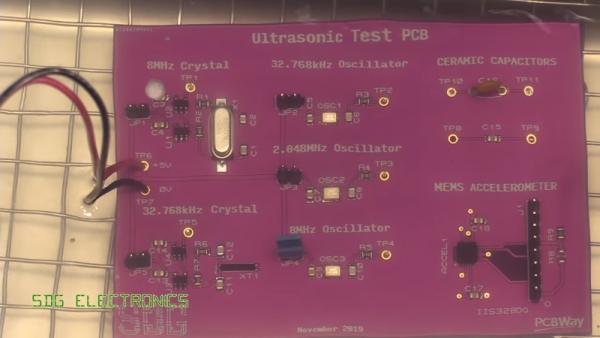
How do you clean the residual flux off your boards? There are plenty of ways to go about the job, ranging from “why bother?” to the careful application of isopropyl alcohol to every joint with a cotton swab. It seems like more and more people are turning to ultrasonic cleaners to get the job done, though, and for good reason: just dunk your board and walk away while cavitation does the work for you.
But just how safe is it to sonically blast the flux off your boards? [SDG Electronics] wanted to know, so he ran some cleaning tests to get to the bottom of things. On the face of it, dunking a PCB in an aqueous cleaning solution seems ill-advised; after all, water and electricity famously don’t mix. But assuming all the nooks and crannies of a board can be dried out before power is applied, the cleaning solution itself should be of little concern. The main beef with ultrasonic cleaning seems to be with the acoustic energy coupling with mechanical systems on boards, such as crystal oscillators or micro-electrical-mechanical systems (MEMS) components, such as accelerometers or microphones. Such components could resonate with the ultrasonic waves and be blasted to bits internally.
To test this, [SDG Electronics] built a board with various potentially vulnerable components, including the popular 32.768-kHz crystal, cut for a frequency quite close to the cleaner’s fundamental. The video below goes into some detail on the before-and-after tests, but the short story is that nothing untoward happened to any of the test circuits. Granted, no components with openings as you might find on some MEMS microphones were tested, so be careful. After all, we know that ultrasound can deal damage, and if it can levitate tiny styrofoam balls, it might just do your circuit in.
Source: HOW SAFE IS THAT ULTRASONIC BATH FOR FLUX REMOVAL?
- How do you clean residual flux off boards?
Dunk the board in an ultrasonic cleaner filled with aqueous cleaning solution and let cavitation do the work. - Is it safe to sonically blast flux off boards?
Tests show nothing untoward happened to test circuits, though caution is needed for specific components. - What are the main risks of ultrasonic cleaning?
The main risk is acoustic energy causing mechanical systems like crystal oscillators or MEMS components to resonate and break internally. - Does water and electricity mix during this process?
No, but assuming all parts are dried out before power is applied, the cleaning solution itself is of little concern. - Can ultrasound damage circuit boards?
Yes, ultrasound can deal damage if it causes internal resonance in vulnerable components or levitates tiny objects. - Were any components damaged in the tests?
Nothing untoward happened to any of the test circuits, including those with 32.768-kHz crystals. - Which components should be handled with care?
Components with openings like some MEMS microphones require extra caution as they were not tested.
