
Summary of REVERSE ENGINEERING A TWO-WIRE INTERCOM
The article details the reverse engineering of a modern two-wire intercom system by Aaron Christophel. While audio remains analog, digital signaling for alarms and functions is transmitted over a constant 24V DC line using pulse trains. The project utilizes an oscilloscope to analyze these signals and an Arduino circuit with custom software to send and receive them, with code available on GitHub.
Parts used in the Two-Wire Intercom Reverse Engineering Project:
- Two-wire intercom system
- Audio amplifier
- Oscilloscope
- Arduino microcontroller
- Circuitry for pulse transmission and reception
- GitHub repository containing software code
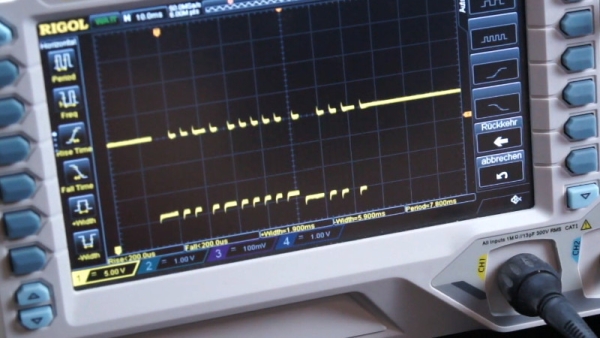
There was a time when an intercom was simply a pair of boxes with speakers joined by a couple of wires, with an audio amplifier somewhere in the mix. But intercoms have like everything else joined the digital age, so those two wires now carry a load of other functionality as digital signalling. [Aaron Christophel] installs these devices for a living, and has posted a fascinating reverse engineering video that we’ve also placed below the break.
Power for the system is present as a constant 24V DC, and the audio is still an old-fashioned analogue signal that we’ll all be familiar with. On that 24V DC though are imposed a series of pulse trains to trigger the different alarms and other functions, and he describes extracting these with an oscilloscope before showing us the circuitry he’s used to send and receive pulses with an Arduino. The bulk of the video is then devoted to the software on the Arduino, which you can also find in a GitHub repository.
The result is an interesting primer for anyone who fancies a bit of serial detective work, even if they don’t have a intercom to hand.
Source: REVERSE ENGINEERING A TWO-WIRE INTERCOM
- How does power work in this intercom system?
Power is provided as a constant 24V DC supply. - What type of signal carries the audio?
The audio is transmitted as an old-fashioned analogue signal. - How are alarms and other functions triggered digitally?
A series of pulse trains are imposed on the 24V DC line to trigger different functions. - What tool was used to extract the digital pulse signals?
An oscilloscope was used to extract the pulse trains from the power line. - Which device is used to send and receive the pulses?
An Arduino is used to send and receive the pulses via specific circuitry. - Where can the software code for the Arduino be found?
The software code is available in a GitHub repository linked in the article. - Does the modern intercom still use wires like older models?
Yes, it uses two wires that now carry digital signalling in addition to power and audio.
