
Summary of BACK TO BASICS WITH AN ARDUINO AND AN EEPROM
This article introduces the I2C EEPROM as a reliable component for storing configuration data that is rarely written but frequently read. It specifically demonstrates using an ST24C04 512-byte chip with an Arduino Mega, detailing the necessary wiring and providing sample code to facilitate easy integration into future hardware projects.
Parts used in the Arduino and EEPROM Project:
- ST24C04 512-byte I2C EEPROM
- Arduino Mega
- Pull-down resistors
There are plenty of techniques and components that we use in our everyday hardware work, for which their connection and coding is almost a done deal. We are familiar with them and have used them before, so we drop them in without a second thought. But what about the first time we used them, we had to learn somewhere, right? [TheMagicSmoke] has produced just what we’d have needed then for one component that’s ubiquitous, the I2C EEPROM.
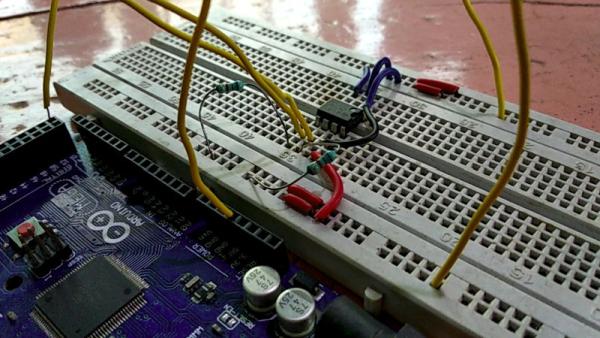
These chips provide relatively small quantities of non-volatile memory storage, and though they are not the fastest of memory technologies they have a ready application in holding configuration or other often-read and rarely written data.
Since the ST24C04 512-byte device in question has an I2C bus it’s a straightforward add-on for an Arduino Mega, so we’re shown the wiring for which only a couple of pull-down resistors are required, and some sample code. It’s not the most complex of projects, but it succinctly shows what you need to do so that you too can incorporate an EEPROM in your work.
If learning about I2C EEPROMs piques your interest, perhaps you’d like to read a previous look we made at them.
Source: BACK TO BASICS WITH AN ARDUINO AND AN EEPROM
- What is the primary application of I2C EEPROMs described?
Holding configuration or other often-read and rarely written data. - How many pull-down resistors are required for the wiring?
Only a couple of pull-down resistors are required. - Does the ST24C04 device use an I2C bus?
Yes, the ST24C04 has an I2C bus. - Can this project be straightforwardly added to an Arduino Mega?
Yes, it is a straightforward add-on for an Arduino Mega. - What does the article provide regarding the code?
The article provides some sample code. - Is the I2C EEPROM technology considered fast?
No, they are not the fastest of memory technologies. - What type of memory storage do these chips provide?
They provide relatively small quantities of non-volatile memory storage. - Why might someone need to learn about I2C EEPROMs?
To incorporate an EEPROM in their work effectively.
