
Summary of SIMPLE ULTRASOUND MACHINE SHOWS THE SKELETON LURKING INSIDE US ALL
This article describes a DIY ultrasound scanner built from inexpensive eBay components, using a paint-thickness meter transducer, a boost converter and 74121 one-shot to generate ~100 V pulses at ~5 MHz, AD811 amplifiers and an LM7171 peak detector on receive, and an Arduino Due with a 320×480 LCD to display echoes that reveal skin and bone reflections. The project was inspired by the open-source Murgen ultrasound project.
Parts used in the Simple Ultrasound Machine:
- Paint-thickness meter transducer (from commercial unit)
- Boost converter (for high-voltage generation)
- 74121 Schmitt-trigger one-shot
- MOSFET (high-voltage switching)
- AD811 op amps (three-stage amplifier)
- LM7171 op amp (rectifier and peak detector)
- Arduino Due
- 320×480 LCD display
- Various eBay-sourced modules and components (wiring, PCB, connectors)
That first glimpse of a child in the womb as a black and white image on a screen is a thrilling moment for any parent-to-be, made possible by several hundred thousand dollars worth of precision medical instrumentation. This ultrasound machine cobbled together from eBay parts and modules is not that machine by a long shot, but it’s still a very cool project that actually gives a peek inside the skin.
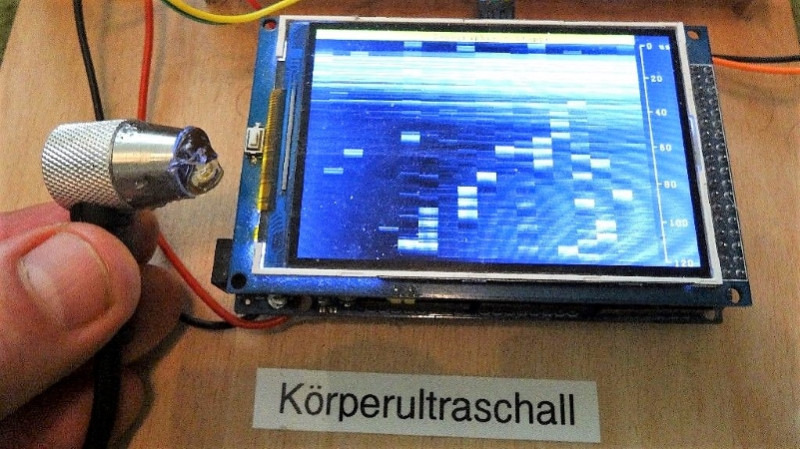
The ultrasound transducer used by [stoppi71] in this build has an unusual source: a commercial paint-thickness meter. Cue the jokes about watching paint dry, but coatings measurement is serious stuff. Even so, the meter in question only ran about $40 on eBay, and provided the perfect transducer for the build. The sender needs a 100V pulse at about 5 MHz, so [stoppi71] had some fun with a boost converter and a 74121 Schmitt-trigger one-shot driving a MOSFET to switch the high voltage. On the receive side, the faint echo is sent through a three-stage amp using AD811 op amps before going through an LM7171 op amp acting as a rectifier and peak detector. Echos are sent to an Arduino Due for display on a 320×480 LCD. The resolution isn’t great, but the video below shows that it’s enough to see reflections from the skin of [stoppi71]’s forearm and from the bones within.
[stoppi71] says that he was inspired to tackle this build by Murgen, an open-source ultrasound project. That project got further refined and entered into the “Best Product” category in the 2018 Hackaday Prize. We like that because focusing on turning projects into products is what this year’s Hackaday Prize is all about.Source: SIMPLE ULTRASOUND MACHINE SHOWS THE SKELETON LURKING INSIDE US ALL
- What transducer was used in the build?
A paint-thickness meter transducer sourced from a commercial unit purchased on eBay was used. - How is the high-voltage pulse generated?
A boost converter supplies the high voltage, and a 74121 Schmitt-trigger one-shot drives a MOSFET to switch the ~100 V pulse. - What frequency is the ultrasound pulse?
The transmitter needs about a 5 MHz pulse. - How are received echoes amplified?
Echoes go through a three-stage amplifier using AD811 op amps. - How are echoes detected after amplification?
An LM7171 op amp is used as a rectifier and peak detector for the received signal. - What microcontroller and display are used?
An Arduino Due is used to process and display echoes on a 320×480 LCD. - Can this DIY machine image beneath the skin?
Yes; the display shows reflections from the skin and from bones in the forearm, though resolution is limited. - Where did the project inspiration come from?
The builder was inspired by the open-source Murgen ultrasound project.
