
Summary of AN ARDUINO CARBON FIBER WRAPPING MACHINE
This article details [Bryan Kevan]'s DIY carbon fiber tube wrapping machine, built to drastically reduce costs compared to commercial options. By automating the manual process of wrapping carbon tow around a rotating mandrel with epoxy, he achieved a 95% price reduction. The project utilizes an Arduino Uno and stepper motors to control precise winding patterns on a PVC pipe mandrel, resulting in strong, lightweight tubes suitable for applications like bike frames.
Parts used in the Carbon Fiber Wrapping Machine:
- PVC pipe (mandrel)
- Carbon fiber ribbon (tow)
- Epoxy
- GT2 belt and pulleys
- 20/20 aluminum extrusion (frame)
- Arduino Uno
- Two stepper motors
- Stepper motor drivers
- 3D printed parts
- WD-40
- Parchment paper
- 3M blue painter's tape
Many of the projects we feature on Hackaday are motivated by pure greed. Not on the part of the hacker, mind you; but rather the company that’s charging such an outrageous price for a mass produced item that somebody decides they can do the same thing cheaper as a one-off project. Which is precisely how [Bryan Kevan] ended up building his own carbon fiber tube wrapping machine. Not only do the finished tubes look fantastic, but they cost him a fraction of what even the “cheap” commercial ones cost.
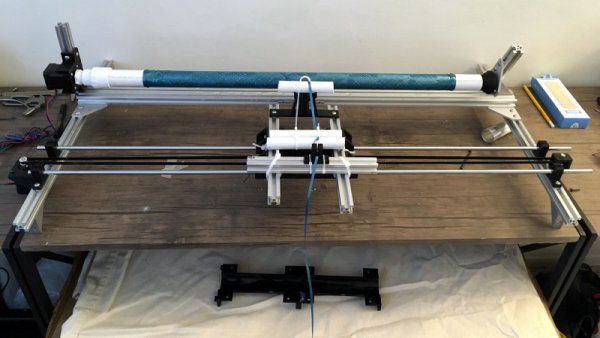
The principle behind producing the tubes is really pretty simple: carbon fiber ribbon (or “tow”, in the official parlance) gets wrapped around a rotating mandrel, ideally in interesting patterns, and epoxy is added to bind it all together. When it’s hardened up, you slide the new carbon fiber tube off the mandrel and away you go building a bike frame or whatever it is you needed light and strong tubes for. You could even do it by hand, if you had enough patience.
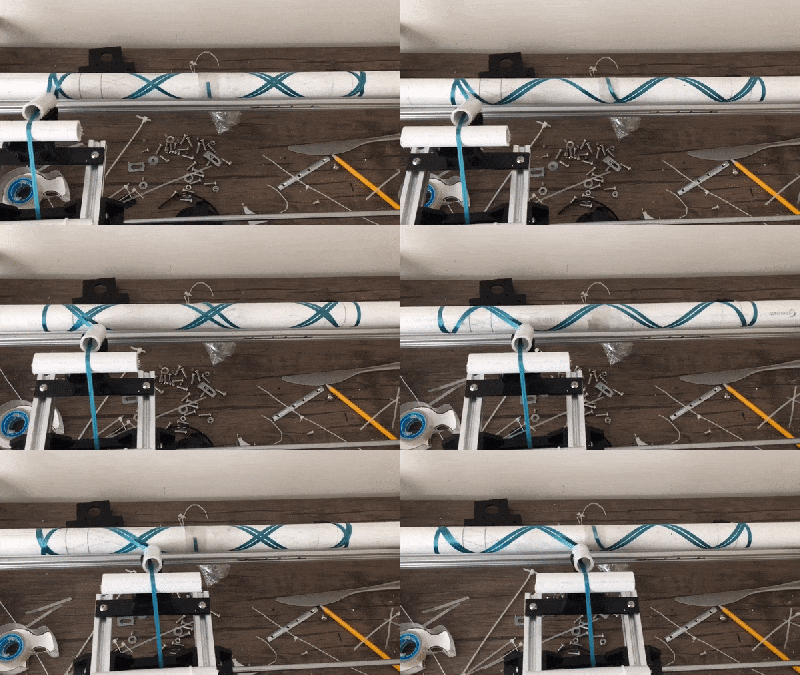
The frame of the winder is built from the hacker’s favorite: 20/20 aluminum extrusion. Add to that an Arduino Uno, two stepper motors with their appropriate drivers, and the usual assortment of 3D printed odds and ends. [Bryan] says getting the math figured out for generating interesting wrap patterns was a bit tricky and took a fair amount of trial and error, but wasn’t a showstopper. Though we’d suggest following his example and using party ribbon during testing rather than the carbon stuff, as producing a few bird nests at the onset seems almost a guarantee.
One of the trickiest parts of the project ended up being removing the carbon fiber tubes from the PVC mandrel once they were done. [Bryan] eventually settled on a process which involved spraying the PVC with WD-40, wrapping it in parchment paper, and then using a strip of 3M blue painter’s tape to keep the parchment paper from moving. If you can toss the whole mandrel in the freezer after wrapping to shrink it down a bit, even better.
So was all this work worth it in the end? [Bryan] says he was originally looking at spending up to $70 USD per foot for the carbon fiber tubes he needed for his bike frame, but by buying the raw materials and winding them himself, he ended up producing his tubes for closer to $3 per foot. Some might question the strength and consistency of these DIY tubes, but for a ~95% price reduction, we’d be willing to give it a shot.
Years ago we covered a Kickstarter campaign for a very similar carbon winder. Probably due to the relatively limited uses of such a gadget, the winder didn’t hit the funding goal. But just like the current wave of very impressive homebrew laser cutters, the best results might come from just building the thing yourself.
Source:AN ARDUINO CARBON FIBER WRAPPING MACHINE
-
How does the carbon fiber wrapping machine operate?
The machine rotates a horizontal PVC pipe mandrel while moving a car carrying carbon fiber ribbon back and forth along its length to wrap it with epoxy. -
What is the primary motivation behind building this machine?
The goal was to produce carbon fiber tubes at a fraction of the cost of mass-produced commercial items which can be outrageously priced. -
Which components are used to construct the frame?
The frame is built using 20/20 aluminum extrusion. -
Can you automate the wrapping process by hand?
You could do it by hand if you have enough patience, but automation ensures a more uniform-looking final product. -
What material should be used during testing instead of carbon fiber?
Party ribbon should be used during testing to avoid creating bird nests of wasted carbon fiber. -
How are the finished tubes removed from the mandrel?
The process involves spraying the PVC with WD-40, wrapping it in parchment paper secured with 3M blue painter's tape, and optionally freezing the mandrel to shrink it. -
What is the cost difference between buying and making the tubes?
Commercial tubes cost up to $70 per foot, while homemade tubes cost closer to $3 per foot. -
Was finding the math for wrap patterns difficult?
Yes, generating interesting wrap patterns required a fair amount of trial and error but was not a showstopper.
