
Summary of EXTENDED BATTERY LIFE IN PORTABLE DEVICES WITH NEW LOW IQ LDO
Microchip's MCP1811 LDO regulator extends portable device battery life up to four times longer than traditional units by achieving an ultra-low 250nA quiescent current. Ideal for IoT, wearables, and hearing aids, this component minimizes standby power and offers fast transient response to prevent voltage lockout. Its compact 1x1mm packaging saves board space, allowing for larger batteries or more features while ensuring stable operation with ceramic capacitors.
Parts used in the MCP1811 LDO Project:
- MCP1811 LDO Regulator
- Ceramic Output Capacitor (1.0 uF)
- Battery Power Source
Extending battery life in portable devices up to four times longer than traditional ultra-low quiescent (Iq) LDOs, Microchip has announced a linear Low Dropout (LDO) regulator.
With an ultra-low Iq of 250nA versus the approximate 1uA operation of traditional devices, the MCP1811LDO reduces quiescent current to save battery life, enabling end-users to recharge or replace batteries less often. The minimized power consumption enables portable electronic devices to run for months or even years on a single battery.
Well suited for IoT and battery-operated applications such as wearables, remotes, and hearing aids, the 250nA ultra-low Iq reduces power consumption in applications by minimizing standby or shutdown current.
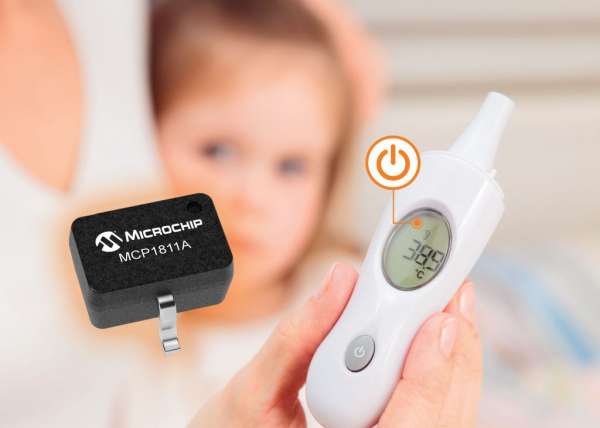
Reducing standby power consumption is critical in remote, battery-powered sensor nodes, where battery replacement is difficult and operating life requirements are high.
Available in package options as small as 1x1mm, the MCP1811 consumes minimal board space to meet the needs of today’s compact portable electronic designs. Depending on the application and number of LDOs, designers can take advantage of the extra board space with a larger battery to further increase battery life.
An additional benefit offered by the MCP1811 is faster load line and transient response when compared to other ultra-low Iq LDOs. Faster response times can accelerate the wake-up speed in devices such as monitors or sensors that require immediate attention.
Faster transient response can help designers to avoid undervoltage and overvoltage lockout measures used in sensitive applications where transient spikes can result in its catastrophic results.
- Ultra-Low Quiescent Current: 250 nA (typical)
- Ultra-Low Shutdown Supply Current: 10 nA typ (MCP1811A) and 5 nA typ (MCP1811B)
- Input Voltage Range: 1.8V to 5.5V
- Standard Output Voltages: 1.0V, 1.2V, 1.8V, 2.0V, 2.5V, 2.8V, 3.0V, 3.3V and 4.0V
- Low Dropout Voltage: 400 mV (typical) w/ Small Variation Over Load Range
- Stable with Ceramic Output Capacitor: 1.0 uF
- Overcurrent Protection w/ Foldback
- Output Discharge (MCP1811A)
- Available in 3 and 5 lead SOT-23, 3 and 5 lead SC70, 4 lead 1x1mm UDFN
- How much does the MCP1811 reduce quiescent current compared to traditional LDOs?
The MCP1811 reduces quiescent current to 250nA, which is significantly lower than the approximate 1uA of traditional devices. - Can this regulator extend battery life in wearable devices?
Yes, it enables devices like wearables to run for months or years on a single battery by minimizing power consumption. - What are the available package sizes for the MCP1811?
It is available in 3 and 5 lead SOT-23, 3 and 5 lead SC70, 4 lead 1x1mm UDFN packages. - Does the MCP1811 offer faster load line response than other ultra-low Iq LDOs?
Yes, it provides faster load line and transient response to accelerate wake-up speeds in sensors and monitors. - What input voltage range does the MCP1811 support?
The device supports an input voltage range from 1.8V to 5.5V. - How does the MCP1811 help avoid catastrophic results in sensitive applications?
Faster transient response helps designers avoid undervoltage and overvoltage lockout measures caused by transient spikes. - Is the MCP1811 stable with ceramic output capacitors?
Yes, it is stable with a 1.0 uF ceramic output capacitor. - What is the typical shutdown supply current for the MCP1811B model?
The typical shutdown supply current for the MCP1811B is 5 nA.
