
Summary of Balance Beam Controller
This project designed an unstable balance beam system to test classical control methods using a microcomputer. A servo motor controlled a teeter-totter beam pivoting on a central fulcrum, aiming to keep a rolling ping pong ball centered. The setup demonstrates real-time balancing challenges through mechanical and electronic integration.
Parts used in the Balance Beam Controller:
- Microcomputer
- Servo motor
- Teeter-totter beam
- Central fulcrum
- Ping pong ball
The purpose of our final project was to create an unstable system that would allow us to investigate classical control design methods by controlling the system using a microcomputer.
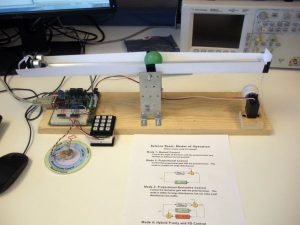
This was accomplished by creating a teeter-totter that pivoted around a central fulcrum and was controlled by a servo. The beam acted as a track for a ping pong ball to roll on, with the goal of balancing the ping pong ball in the center of the beam.
Read More Detail :Balance Beam Controller
- What was the purpose of the final project?
The purpose was to create an unstable system to investigate classical control design methods. - How was the system controlled?
The system was controlled by a microcomputer. - What component acted as the track for the ball?
The beam acted as a track for the ping pong ball to roll on. - What was the goal of the design?
The goal was to balance the ping pong ball in the center of the beam. - What type of pivot point was used?
The teeter-totter pivoted around a central fulcrum. - Which motor was used to control the beam?
A servo was used to control the beam. - Can this system be considered stable?
No, the project created an unstable system. - What method is being investigated with this setup?
The setup investigates classical control design methods.
