
Summary of Chirp Microsystem Made The Smallest And Most Accurate Ultrasonic Time-of-Flight Sensors
Chirp Microsystems launched the CH-101 and CH-201, discrete ultrasonic Time-of-Flight sensors featuring 3.5×3.5mm packages. These MEMS-based devices offer ranges of 1m and 5m respectively, utilizing a shared ASIC and tuned PMUT transducers. They consume significantly less power than conventional rangefinders and enable bezel-free designs for gesture recognition in smartphones and VR applications.
Parts used in Chirp Microsystems Ultrasonic ToF Sensors:
- CH-101 Sensor (2nd Generation)
- CH-201 Sensor (3rd Generation)
- ASIC (Application-Specific Integrated Circuit)
- Piezoelectric Micro-machined Ultrasonic Transducers (PMUT)
- Interrupt Pin
- GIO Pin
- I2C Bus Interface
Recently Californian startup Chirp Microsystems officially announced two discrete ultrasonic Time-of-Flight (ToF) sensors, the CH-101 and CH-201, with maximum sensing ranges of 1m and 5m, respectively. Both chips have a 3.5×3.5mm package and they are powered by same ASIC or application-specific integrated circuit for signal processing. To achieve different sensing ranges, the Piezoelectric Micro-machined Ultrasonic Transducers (PMUT), the MEMS parts of the sensors are tuned and built differently.
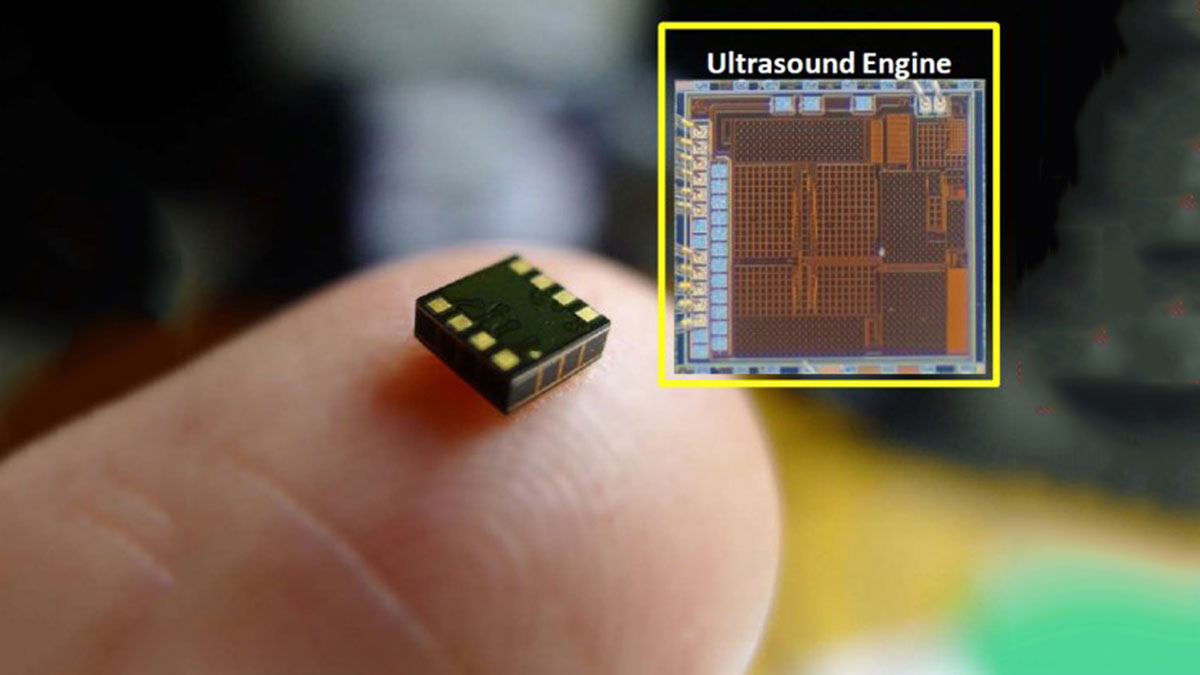
Chirp Microsystems was founded in 2013 and the CH-101 is their 2nd generation design while the CH-201 is an upgraded third generation design. Their 4th generation design of chips is under development and prototypes are being tested recently. Chirp Microsystems declares that with each design so far, they’ve improved their transmitter and receiver performance by 4 times. David Horsley, Chirp Microsystems’ CTO, told,
In fact, we have been sampling the CH101 for two years now and we realized we had never made a product announcement for it.
According to Chirp Microsystems, the chips are the first commercially available MEMS-based ultrasonic ToF sensors and can beat all other ToF solutions on the small size and low power consumption. The “Sonars on a chip” draw 100 times less power and are a thousand times smaller than the conventional ultrasonic rangefinders used in today’s industrial automotive applications. Unlike infrared based ToF sensors, these new MEMS sensors do not rely on optical path clearance. So, it’s now easier for engineers to design bezel-free smartphones with precise gesture recognition.
The CH-101 and CH-201 include an interrupt pin and a GIO pin. That pin is used in hardware trigger mode to connect several transducers on the same I2C bus so they can operate in a synchronous fashion. For Virtual Reality applications, data from multiple chips are mixed to detect the position of user’s hand in 3D space.
Read more: Chirp Microsystem Made The Smallest And Most Accurate Ultrasonic Time-of-Flight Sensors
-
What are the maximum sensing ranges for the CH-101 and CH-201?
The CH-101 has a maximum range of 1 meter, while the CH-201 reaches up to 5 meters. -
How do these sensors compare in size to conventional ultrasonic rangefinders?
These chips are a thousand times smaller than conventional ultrasonic rangefinders used in industrial automotive applications. -
Can engineers use these sensors to design bezel-free smartphones?
Yes, unlike infrared sensors, these MEMS sensors do not rely on optical path clearance, making bezel-free designs easier. -
How much power do these sensors draw compared to traditional solutions?
They draw 100 times less power than conventional ultrasonic rangefinders. -
What pins are included on the CH-101 and CH-201 chips?
The chips include an interrupt pin and a GIO pin for hardware trigger modes. -
How can multiple transducers operate synchronously?
Multiple transducers can be connected on the same I2C bus using the interrupt and GIO pins to operate in a synchronous fashion. -
Are these sensors suitable for Virtual Reality applications?
Yes, data from multiple chips can be mixed to detect the position of a user's hand in 3D space for VR. -
Is there a fourth generation of these chips currently available?
No, the fourth generation design is under development with prototypes being tested recently.
