
Summary of VGADuino-II : The New 256 Color Graphic Shield for Arduino
VGADuino-II is a graphic shield for Arduino that connects to VGA monitors or TVs, eliminating the need for small stacked displays. It features an NXP-LPC1756 ARM microcontroller and XILINX XC95144XL CPLD, supporting 256 colors and 11 font sizes via AT commands over UART. This shield enables users to display text, shapes, and images on large screens with a resolution of 800×600.
Parts used in the VGADuino-II Project:
- NXP-LPC1756 ARM chip
- XILINX XC95144XL CPLD
- SD Ram
- VGA DB15 output connector
- Arduino board
- TV or Monitor with VGA 15 Pin connector
Arduino is pretty much famous for the numerous shields it has. These plug-and-play shields make our life a lot easier while working on some complicated projects. Among all other shields, graphic shields are getting more and more popular. A graphic shield lets you show text, numbers, shapes, and even small images on a screen, using Arduino. VGADuino-II is a new graphic shield which lets you use your TV or any monitor with VGA 15 pin as a large screen for Arduino.
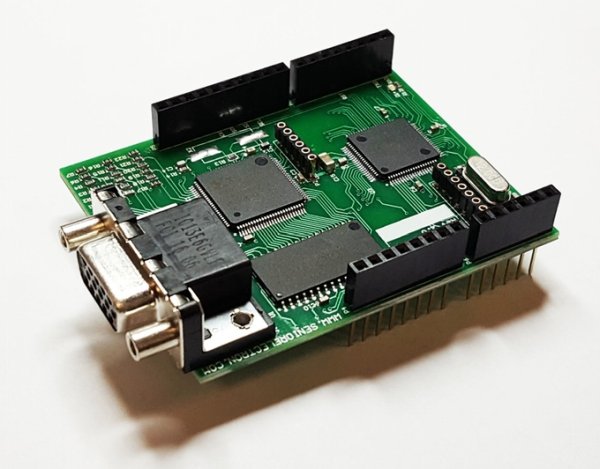
It’s very exciting that you won’t have to rely on those small displays which are stacked on the shield itself, anymore. Rather you are getting a whole TV or VGA monitor to display your data. As Masih Vahida, the creator of VGADuino, says:
VGADuino is a shield that is made for Arduino with all the libraries and samples that user can easily stack it on the Arduino board and starts programming. it can connect Arduino to any kind of TV or Monitor with VGA 15 Pin connector.
Key Features:
- Internal functions to draw various shapes with AT-Commands and Arduino libraries
- 11 Different font sizes with standard ASCII characters support
- 256 color, 8bit RGB format
- Having access to each pixel individually
- Standard VGA DB15 output
- Screen resolution: 800×600 60Hz
- Actual pixels: 400×300 60Hz
Technical Details:
In VGADuino-II, NXP-LPC1756 ARM chip is used as the main microcontroller and XILINX XC95144XL CPLD for refreshing the display and taking care of the sync signals. There is also an SD Ram to keep the screen’s pixel color data.
In this version of VGADuino, each pixel is one byte, that means each pixel has 256 colors which are in standard 8bit RGB format. (3 bits for Red, 3 bits for Green and 2 bits for Blue).
It communicates with Arduino over UART using predefined AT command set. All relevant Arduino libraries are available to implement in code. The user can choose among all 11 fonts with definable background and foreground color of text.
Read more: VGADuino-II : The New 256 Color Graphic Shield for Arduino
- What is VGADuino-II?
It is a new graphic shield for Arduino that lets you use a TV or VGA monitor as a large screen. - How does it connect to displays?
It connects to any kind of TV or Monitor using a standard VGA 15 Pin connector. - What microcontroller powers this shield?
The NXP-LPC1756 ARM chip is used as the main microcontroller. - Does it support color displays?
Yes, it supports 256 colors in an 8-bit RGB format where each pixel is one byte. - Can I change the font size?
Yes, there are 11 different font sizes available with standard ASCII character support. - How does the shield communicate with Arduino?
It communicates over UART using a predefined AT command set. - What is the screen resolution?
The screen resolution is 800×600 at 60Hz with actual pixels of 400×300. - Is programming difficult?
No, it comes with all libraries and samples so users can easily stack it and start programming.
