
Summary of Cheap Arduino Serial Terminal
The author developed a low-cost serial terminal under £5 using an Arduino Nano as an I2C peripheral for an ESP8266 home control system. The project features a custom prototyping board integrating the ESP8266 running Home Control 2016 software and an ATmega328 microcontroller for extra IO pins. While QDTECH 128x160 LCDs were tested, they lacked sufficient resolution. Consequently, the focus shifted to ILI9340-driven 320x240 displays, which offer better monitoring capabilities despite slower drawing speeds on standard processors.
Parts used in the Cheap Arduino Serial Terminal:
- Arduino Nano (or similar 328-based board)
- ESP8266 microcontroller
- ATmega328 microcontroller
- QDTECH 128*160 LCD display
- ILI9340-driven 320*240 display
- I2C bus connections
- Prototyping board
How about a cheap serial terminal for less than a fiver all-in?
In a previous blog entry I’ve been working on more developments for the increasingly powerful home control system using an Arduino as a kind of universal I2c peripheral to the ESP8266. The reason for that is just the vast range of driver software our there and the fact that from China you can get an Arduino-Nano-type-board for under £2. There are drivers for just about everything so it seems daft to just ignore that. It ends up cheaper than most actual i2c peripheral boards.
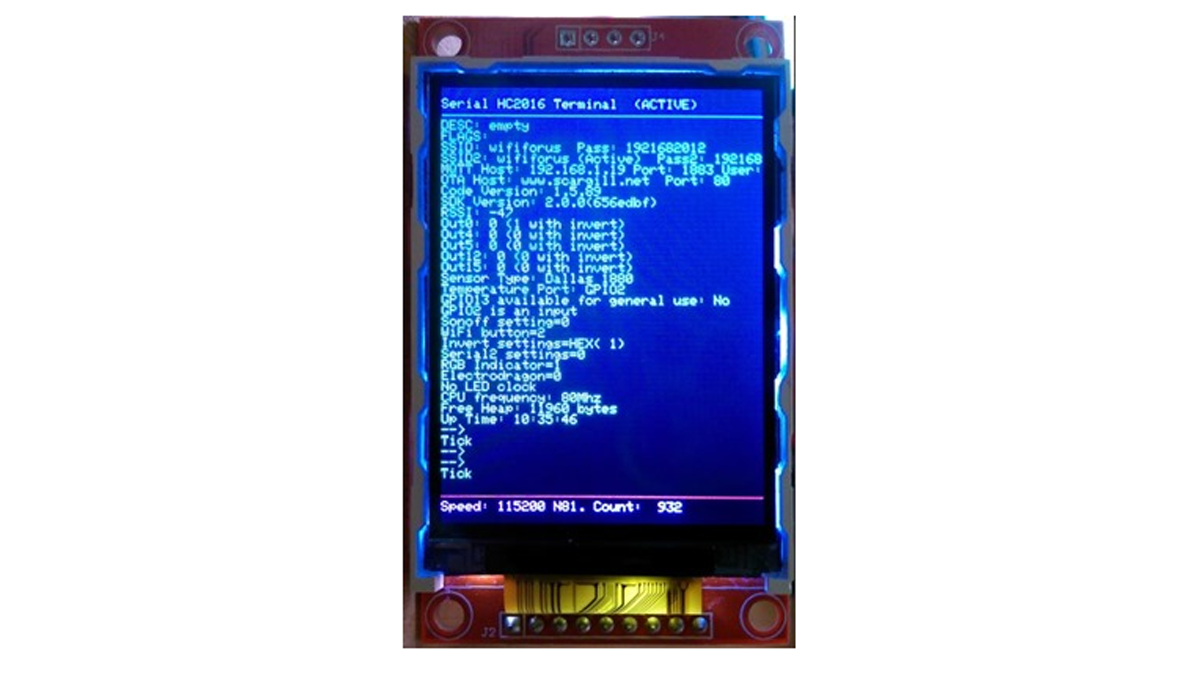
First thing I had to do with the Arduino base code was increase the size of the buffer used for storing I2c and that is covered elsewhere – but finally I got that working. In the process that led me to the idea of a prototyping board with both the ESP8266, running the home control 2016 software AND a 328 to power some peripheral devices and give extra IO pins.
In the process of THAT I got the QDTECH boards running (128*160 LCD – cheap) – and that also is covered in a previous blog entry. These are great – and cheap (though not as cheap since Banggood jacked the price up but thankfully there is still AliExpress – thanks to Squonk for that particular link) but they are a little limited in terms of resolution as any kind of terminal. I even found a little bit of code to do vertical scrolling. Fast enough but then it is a low resolution display.
In the meantime however I pulled out another favourite display of mine, the ILI9340-driven displays at 320*240 – at £3.47 – mind you if you go to the Italian version of Aliexpress they seem to go down to just over £3. The increased resolution of these means you really COULD make a nice monitoring terminal but for one thing – speed. I checked out several implementations including the Adafruit ones and the drawing speed is atrocious – attempts to scroll the display are generally abysmal unless you use a fast processor.
Read more: Cheap Arduino Serial Terminal
-
How can I build a cheap serial terminal for under five pounds?
You can use an Arduino Nano type board costing under two pounds as an I2C peripheral to an ESP8266. -
Why was the Arduino chosen over other I2C peripheral boards?
The Arduino is cheaper than most actual I2C peripheral boards and has a vast range of available driver software. -
What modifications were made to the Arduino base code?
The size of the buffer used for storing I2c data was increased to ensure proper functionality. -
Which display was initially tested but found to be limited?
The QDTECH 128*160 LCD was tested first but proved limited due to its low resolution. -
Where can you find the cheapest ILI9340-driven displays?
The Italian version of AliExpress offers these displays for just over three pounds compared to the standard price. -
What is the main drawback of using ILI9340 displays for this project?
The drawing speed is described as atrocious unless a fast processor is used. -
Does the QDTECH display support scrolling?
Yes, there is code available that allows for vertical scrolling, though it remains slow due to low resolution.
