
Summary of POV Cylinder with Arduino Due
This article details a first-time Arduino project: a Persistence of Vision (POV) Cylinder. Unlike previous globe displays using discrete LEDs, this device uses a rotating styrofoam cylinder wrapped with RGB LED strips to display animated GIFs. The system is powered by an Arduino Due and controlled via Bluetooth from a PC. It features a mechanical chassis with ball bearings and a motor-driven shaft capable of reaching 1300 RPM to create the visual illusion.
Parts used in the POV Cylinder:
- Styrofoam cylinder
- Plywood disks
- Threaded bars
- Ball bearings
- Electric motor
- Crown gears
- Toothed belt
- LPD8806 RGB LED strips
- Arduino Due
- HC06 Bluetooth module
Introduction
This is my first Arduino project. My work was inspired by several maker projects that created Persistence of Vision Displays [2,3,4].
Persistence of vision (POV) refers to the optical illusion whereby multiple discrete images blend into a single image in the human mind and believed to be the explanation for motion perception in cinema and animated films [1].
The projects [2,3,4] implement POV globe displays, using discrete LEDs and discrete shift registers. Instead my device is using a rotating cylinder and off-the-shelf RGB LED strips as POV Display.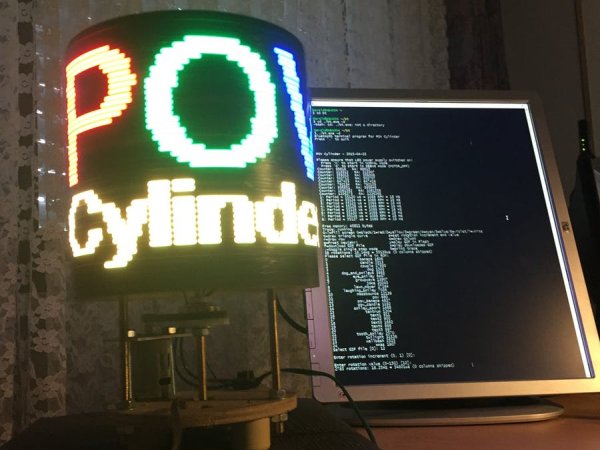
The main features of my POV Cylinder are:
- POV (Persistence of Vision) Display
- Displays animated GIF pictures on a rotating cylinder
- The GIF pictures are stored in Arduino’s RAM or Flash
- Communication with PC via Bluetooth
Technical Overview
- Cylinder Diameter: 200 mm
- Cylinder Height: 200 mm
- Cylinder material: Styrofoam
- Cylinder weight: 420 g
- 4 RGB LED Strips based on LPD8806
- Screen size 151 x 40 pixels
- Based on Arduino Due
- Includes HC06 Bluetooth module
- Controlled via Bluetooth from a PC
Mechanical Construction
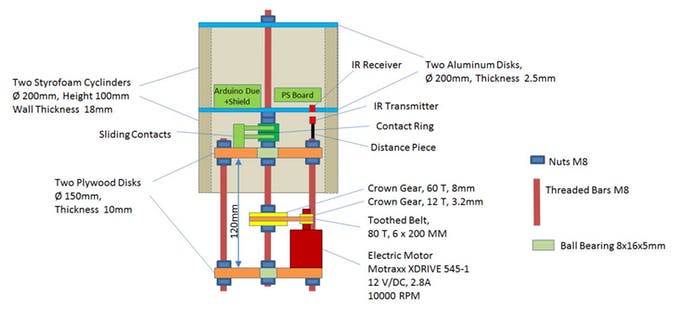
The mechanical construction is shown in the drawing below.
- What is the main optical principle behind this device?
The device relies on Persistence of Vision, an optical illusion where discrete images blend into a single image in the human mind. - How are the animated pictures stored?
The GIF pictures are stored in the Arduino's RAM or Flash memory. - Can the device be controlled remotely?
Yes, it communicates with a PC via Bluetooth for control. - What type of microcontroller is used in this project?
The project is based on the Arduino Due. - What is the maximum rotation speed of the cylinder?
The rotation speed can reach up to 1300 RPM, which equals 22 Hz. - What material is used for the cylinder body?
The cylinder is made of Styrofoam and weighs 420 g. - How many RGB LED strips are used for the screen?
The device uses four RGB LED strips based on LPD8806. - What components drive the shaft rotation?
An electric motor drives the shaft via two crown gears and a toothed belt.
