
Summary of Long Distance Remote Light Sensor With RFM95W/RFM98W LoRa
This tutorial demonstrates creating a long-distance remote light sensor using Arduino UNO boards and Makerfabs LoRa shields. Unlike Wi-Fi, LoRa enables data transmission over 5km+ without internet. The guide covers hardware assembly with a photoresistor and programming via Visuino to transmit sensor data between two boards.
Parts used in the Long Distance Remote Light Sensor:
- Two Arduino UNO compatible boards
- Two Makerfabs LoRa Radio Shields (RFM98W 433MHz or RFM95W 868MHz)
- One Photoresistor Sensor module
- Three Female-Male jumper wires
There are many wireless communication options when connecting Arduino boards. One of the most popular ones is the Wi-Fi. It works well at small distances, and around Wi-Fi hotspots, however when the modules need to connect over long distance at areas where Internet is not present, Wi-Fi is not an option. Luckily there is a great and easily available alternative – the LoRa (Long Range Wide-area network) modules allow sending small packets of data between modules over very long distances (5 Km or more) .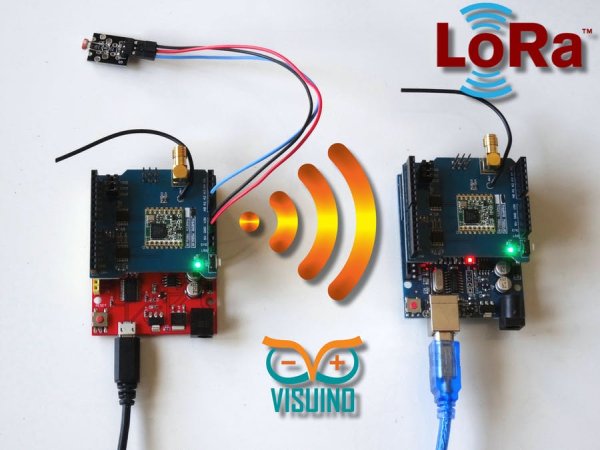
Visuino has support for a number of LoRa Modules, and I was planning tutorial for quite some time, since I had some Adafruit LoRa modules. However, recently the great people at Makerfabs, sent me 2 RFM95W 868MHz based LoRa Shields, and even a great Arduino UNO compatible Maduino UNO board. The Makerfabs modules are of exceptionally good quality, and I decided to make this tutorial with them.
In this tutorial I will show you how easy it is to install the LoRa shields on 2 Arduino UNO boards, and program them with Visuino to transmit data over long distance.
Step 1: Components
- Two Arduino UNOcompatible boards (I use one Arduino UNO generic clone, and one Maduino UNO from Makerfabs, but any other will be just fine)
- Two Makerfabs LoRa Radio Shields ( RFM98W 433MHz, or RFM95W 868MHz ) Make sure both shields are the same type, otherwise they will not be able to communicate
- One Photoresistor Sensor module I got from this cheap 37 sensors set
- 3 Female-Male jumper wires
Step 2: Connect the Makerfabs LoRa Shield, and the Light Sensor Module to Arduino
First we will assemble the Sending Arduino project:
- Plug the LoRa Shield on top of the Arduino Uno as shown on the Pictures 1, 2, 3, and 4 and on the Video
- Connect Female ends of the Ground(Black wire), Power(Red wire), and Signal(Blue wire) to the Photoresistor Module (Picture 5)
- Connect the other end of the Ground wire(Black wire) to the Ground pin of the Arduino board (Picture 6)
- Connect the other end of the Power wire(Red wire) to the 5V power pin of the Arduino board (Picture 6)
- Connect the other end of the Signal wire(Blue wire) to the Analog pin 0 of the Arduino board (Picture 6)
Step 3: Start Visuino, and Add LoRa Shield to the Arduino Component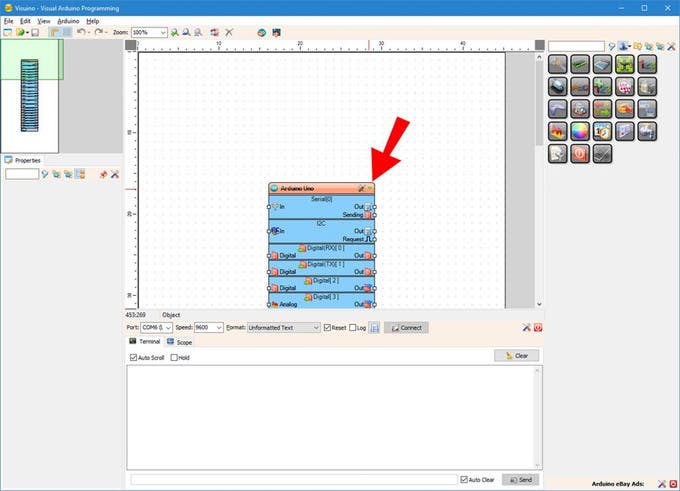
To start programming the Arduino, you will need to have the Arduino IDE installed from here: http://www.arduino.cc/.
For more detail: Long Distance Remote Light Sensor With RFM95W/RFM98W LoRa
- Why choose LoRa over Wi-Fi for this project?
LoRa allows sending small packets of data over very long distances like 5 Km or more where Internet is not present. - Which specific LoRa modules are recommended for this tutorial?
The tutorial recommends Makerfabs LoRa Radio Shields such as RFM98W 433MHz or RFM95W 868MHz. - What type of Arduino boards can be used?
You can use any two Arduino UNO compatible boards, including generic clones or Maduino UNO from Makerfabs. - Do both LoRa shields need to be the same model?
Yes, both shields must be the same type otherwise they will not be able to communicate. - How do I connect the Photoresistor Signal wire?
Connect the blue Signal wire from the module to Analog pin 0 of the Arduino board. - Where should the Ground and Power wires be connected on the Arduino?
The black Ground wire connects to the Ground pin and the red Power wire connects to the 5V power pin. - What software is required to program the Arduino for this project?
You need the Arduino IDE installed along with Visuino to add the LoRa Shield component. - Can I use different frequency LoRa shields together?
No, you cannot use different types; both shields must match to ensure communication.
