
Summary of Arduino Resistance Data Logger
This article describes a low-cost Arduino-based data logger designed to record sensor resistance and temperature simultaneously. The third prototype features a custom PCB created using Fritzing software. The system utilizes a resistive divider circuit to measure unknown sensor resistance against a known reference resistor, capturing voltage output on an SD card. Data processing is simplified by storing the MATLAB conversion script directly on the SD card alongside the collected logs, allowing for convenient offline analysis without external dependencies.
Parts used in the Arduino Resistance Data Logger:
- Arduino
- Sensor (unknown resistor)
- Reference resistor (known resistor)
- SD card
- Matlab script
- Fritzing software
- PCB (Printed Circuit Board)
I was working on a project were I needed a cheap and efficient way to log the changing resistance of a sensor while simultaneously logging the temperature. This project is similar in many respects to the other data loggers on my site. Three prototypes have been built with the third one being a PCB. I have found this design to work extremely well for my needs.
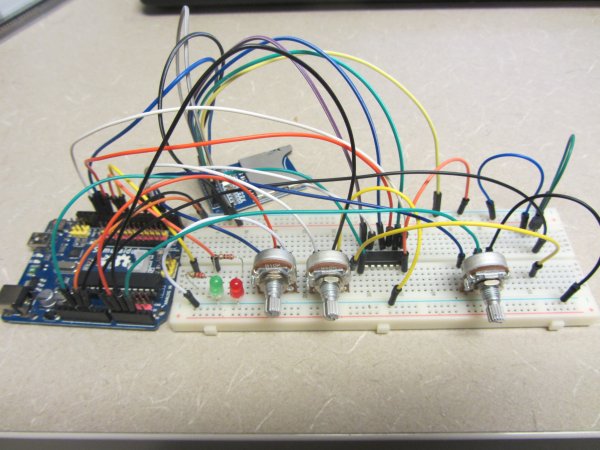
The resistance measurement principle is based on a simple resistive divider. An unknown resistor (the sensor in my case) is attached to the top leg of the divider, while a known resistor (reference resistor) is attached to the bottom leg of the resistor. The voltage between the two resistors (V_out) is than measured and stored on a SD card. The stored voltage data is than manipulated in MATLAB and converted into a resistance value based on the size of the reference resistor. The SD card is able to hold both the collected data from the Arduino, and the MATLAB script used for converting the data into resistance. Keeping the MATLAB script on the SD card allows for easy and convenient data processing without having keep a data processing script in a separate location.
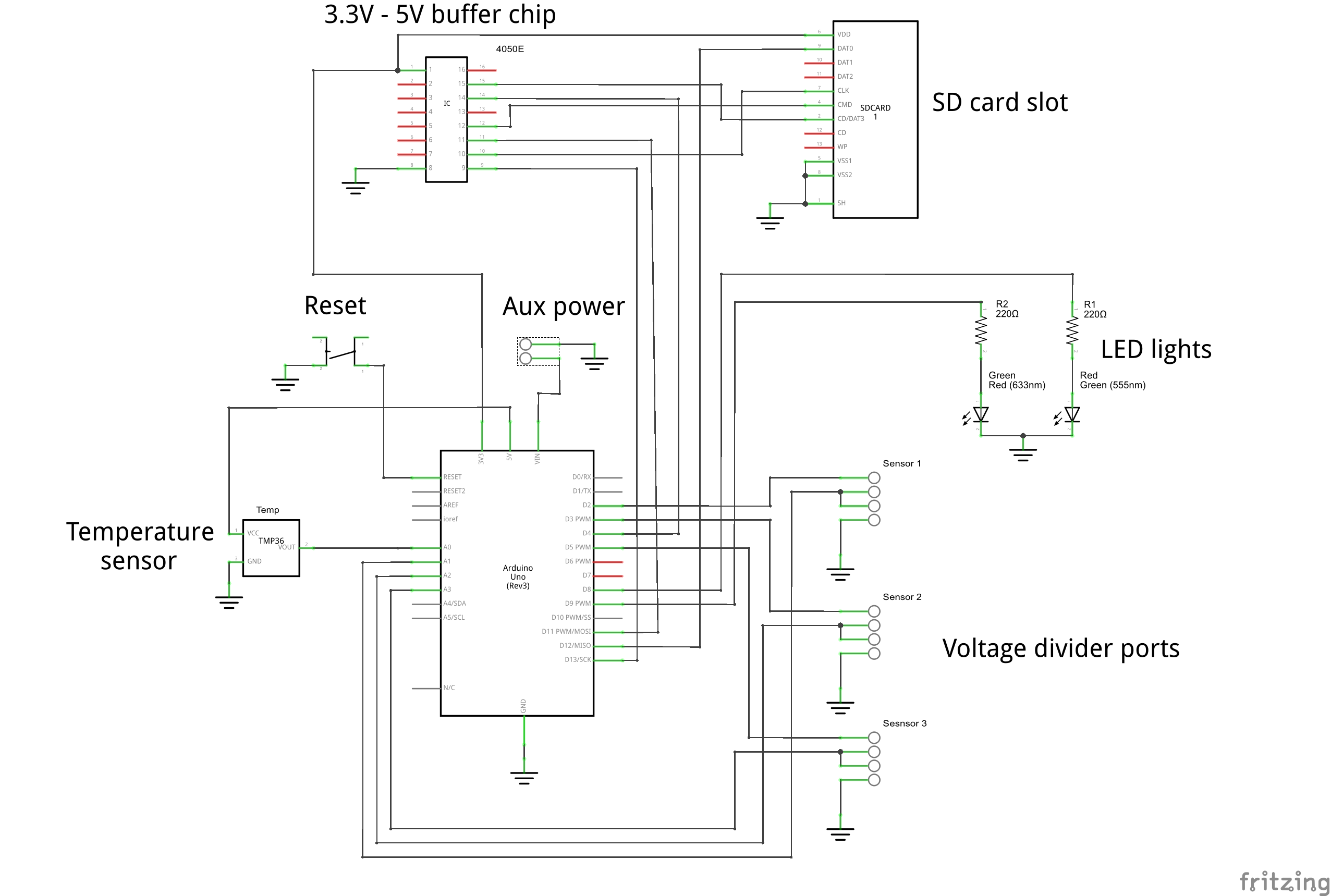
Arduio Shield Layout
The layout of the Arduino shield was done in Fritzing. Fritzing is an open source circuit hardware layout tool that is being developed at the University of Potsdam in Germany. More information on Fritzing can be found here. Below are few key points of the schematic;
For More Detail : Arduino Resistance Data Logger
- What principle does the resistance measurement use?
The principle is based on a simple resistive divider with an unknown resistor on top and a known reference resistor on the bottom. - How is the voltage data stored?
The voltage between the two resistors is measured and stored on an SD card. - Can I process the data without a computer?
No, the stored voltage data must be manipulated in MATLAB to convert it into a resistance value. - Why keep the MATLAB script on the SD card?
Keeping the script on the SD card allows for easy and convenient data processing without needing to keep the script in a separate location. - Which tool was used to design the shield layout?
The Arduino shield layout was done in Fritzing, an open source circuit hardware layout tool. - How many prototypes were built for this project?
Three prototypes have been built, with the third one being a PCB. - Does the SD card hold both data and scripts?
Yes, the SD card holds the collected data from the Arduino and the MATLAB script used for converting the data.
