
Summary of Morse Code Decoder
Morse code is a robust signaling method using dots and dashes, resilient to poor signal conditions and suitable for human decoding. This project captures Morse via an electret microphone, amplifies and bandpass-filters the audio with a common-emitter transistor stage, then detects tones with an NE567 PLL decoder. The NE567 outputs the dot-dash pattern, driving an LED for tuning and feeding a PIC16F84 microcontroller for further processing.
Parts used in the Morse Code Decoder:
- Electret microphone
- Transistor (common-emitter amplifier/follower)
- Coupling capacitors
- Feedback capacitor (between transistor base and collector)
- NE567 PLL tone detector/decoder
- LED (receiver tuning aid)
- PIC16F84 microcontroller
Morse code is used in telecommunication; it is a method of transmitting and receiving coded information. Each character (letter or numeral) is coded/represented by a unique sequence of dots and dashes. Compared to voice, Morse code is less sensitive to poor signal conditions, yet still comprehensible to humans without a decoding device, therefore, a useful alternative to synthesized speech for sending automated data to skilled listeners (radio operator) on a voice channel.
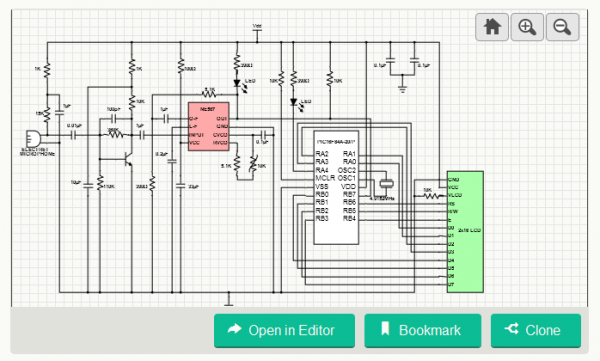
The project’s first part is composed of an electret microphone followed by a common emitter follower amplifier; this transistor amplifier also acts as a first level bandpass filter. Its band edges are determined by the size of the coupling capacitors, and the feedback capacitor between the transistor’s base and collector terminals. The next part of the project is the PLL (phase lock loop) tone detector/decoder NE567; its output is a one-zero pattern replicating the dots-and-dashes sequence of the received signal. This output drives both an input to the PIC16F84 microcontroller and an LED that is used as a receiver tuning aid.
For more detail: Morse Code Decoder
- What is the purpose of the electret microphone in the project?
The electret microphone captures the incoming Morse audio for amplification and decoding. - How does the transistor amplifier contribute to the circuit?
The common-emitter transistor amplifier amplifies the microphone signal and acts as a first level bandpass filter. - What determines the band edges of the amplifier stage?
The size of the coupling capacitors and the feedback capacitor between the transistor base and collector determine the band edges. - What role does the NE567 PLL tone detector play?
The NE567 detects the tone and outputs a one-zero pattern that replicates the dots-and-dashes sequence. - How is the NE567 output used in the project?
The NE567 output drives an LED for receiver tuning and serves as an input to the PIC16F84 microcontroller. - Why is an LED included in the receiver section?
The LED is used as a receiver tuning aid to indicate detection of the Morse tone. - Which microcontroller is used to process the decoded output?
The PIC16F84 microcontroller processes the one-zero pattern from the NE567.
