
Summary of Arduino or Pi? You Choose
The Freetronics PiLeven is an Arduino Uno-compatible board designed to mount directly on a Raspberry Pi. It solves the Pi's power and I/O limitations by providing a high-current switchmode power supply (7–18V DC input) that powers both the Pi and the board, eliminating the need for a regulated 5V USB connection. The board includes level shifters for safe communication between the 3.3V Pi and 5V logic, supports serial uploads from the Pi, and allows standard Arduino shields to be used with the Raspberry Pi.
Parts used in the Freetronics PiLeven Project:
- Raspberry Pi (Model B or B+)
- Freetronics PiLeven Board
- Arduino Uno-compatible circuitry
- High-current switchmode power supply
- Standard 2.1 mm DC jack
- Raspberry Pi expansion headers
- Level shifters
- Serial communication interface
- Standard Arduino shields
The Raspberry Pi is much more powerful than an Arduino but it has a few limitations of its own. Its I/O is much more limited, it can’t use common Arduino shields, and it needs a regulated 5V power supply via its USB connection. All those limitations are solved with the PiLeven.
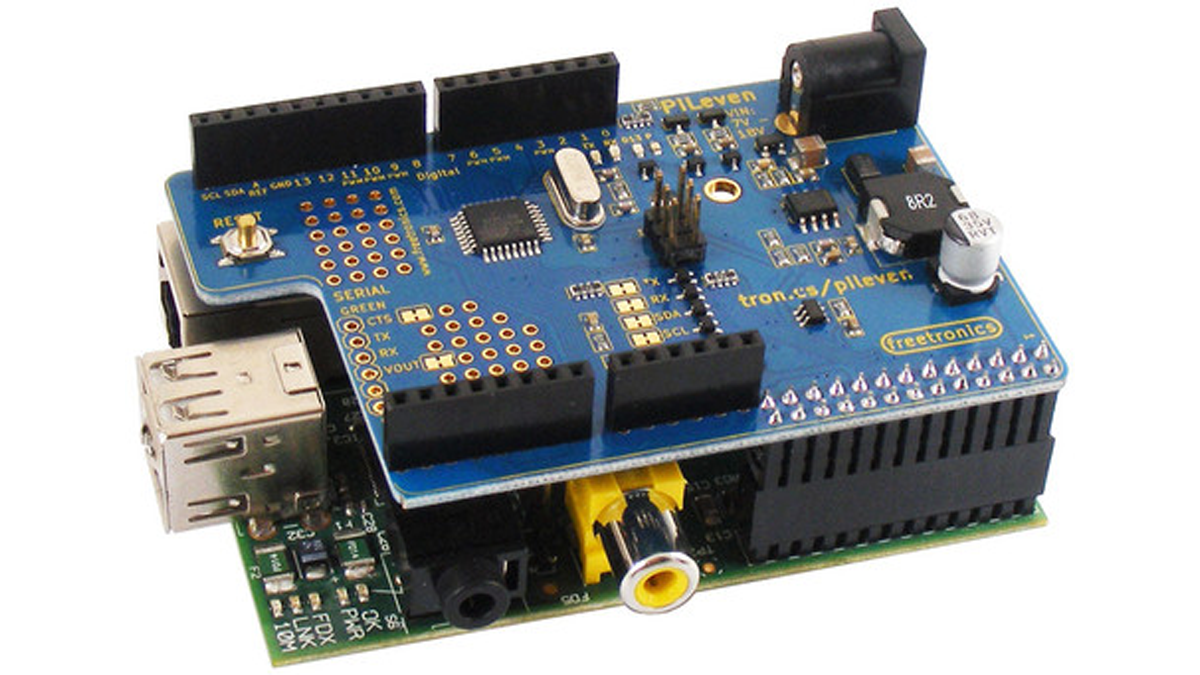
The Freetronics PiLeven is an Arduino-compatible board based on the Arduino Uno, but with a few changes. Obviously it’s a bit of a strange shape! The PiLeven fits right on top of a Raspberry Pi (either model B or B+) using the Raspberry Pi expansion headers. The PiLeven also has a high-current switchmode power supply, so you can plug in anything from 7 to 18 V DC using a standard 2.1 mm jack. The PiLeven can power the Raspberry Pi, so you don’t need a regulated 5V USB connection anymore.
Serial communications on the PiLeven is linked through to the Raspberry Pi, so your Pi can upload new sketches straight to the PiLeven or send/receive data and commands. Also included are level shifters so the 3.3V Pi can talk safely to the 5V PiLeven. You can plug standard Arduino shields right into the PiLeven, giving your Raspberry Pi access to the huge range of shields already available.
For more detail: Arduino or Pi? You Choose
- What problem does the PiLeven solve for the Raspberry Pi?
It solves the Raspberry Pi's limited I/O, inability to use Arduino shields, and need for a regulated 5V USB power supply. - How does the PiLeven power the Raspberry Pi?
The PiLeven uses a high-current switchmode power supply accepting 7 to 18 V DC via a 2.1 mm jack to power both itself and the Pi. - Can you upload sketches from the Raspberry Pi to the PiLeven?
Yes, serial communications are linked so the Pi can upload new sketches straight to the PiLeven. - Do standard Arduino shields work with this setup?
Yes, you can plug standard Arduino shields right into the PiLeven to give your Raspberry Pi access to them. - How does the PiLeven handle voltage differences between the Pi and the board?
It includes level shifters so the 3.3V Pi can talk safely to the 5V PiLeven. - What power input range does the PiLeven accept?
The board accepts a DC input ranging from 7 to 18 volts through a standard 2.1 mm jack. - Which Raspberry Pi models are compatible with the PiLeven?
The PiLeven fits on top of either the Raspberry Pi Model B or Model B+ - Is the PiLeven based on a specific microcontroller architecture?
The PiLeven is an Arduino-compatible board based on the Arduino Uno architecture. - Does the PiLeven require a separate 5V USB connection?
No, the PiLeven powers the Raspberry Pi so you do not need a regulated 5V USB connection anymore.
