
Summary of GPS Tracker for Alzheimer’s Patients
This project is a GPS tracking device for Alzheimer’s and dementia patients, built from readily available components and housed in a 3D-printed case. An Arduino microcontroller interfaces with a GPS module and an Adafruit FONA cellular module; when the GPS leaves a user-defined boundary, the device sends a text alert. It prioritizes simplicity, durability, and secure attachment, with future work aimed at miniaturization. Team members Sean Halloran and Gvozden Suvajlo conceived and executed the design.
Parts used in the GPS Tracker for Alzheimer's Patients:
- Arduino Micro
- GPS Breakout Board
- Adafruit FONA board (cell module)
- GPS Antenna
- 9V battery
- 3.7V battery 500mAh or greater
- Pin headers
- Female to female jumper wires
- Four #6-32 screws 2 inch length
- Four nuts for #6-32 screws
- Six 2.5mm by 8mm machine screws
- Six 2.5mm nuts
- Two 2mm screws
- Two 2mm nuts
- One tamper proof pin 1/4 inch barrel diameter
- 3D-printed case (or alternative enclosure)
- Optional solar charging board and solar panels
First a thank you to my Team members Sean Halloran and Gvozden Suvajlo, they came up with this idea and executed it, this project would not be possible without their ideas and skills.
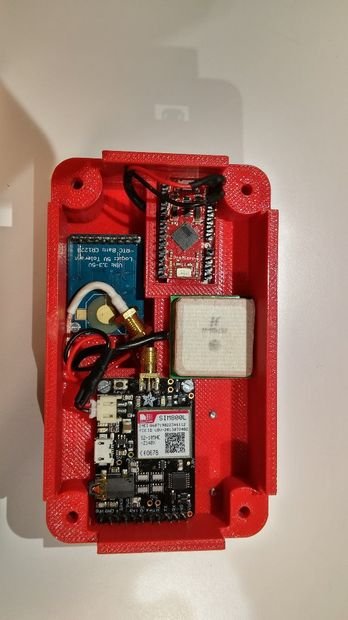
The GPS tracking device is composed of a micro controller, GPS module, cell module, and batteries
all housed in a 3D printed case. The micro controller is programmed to
communicate with both the cell module and GPS module. When the GPS module is
not within a user-specified boundary, the device will send a text message
alert. We made a device that can track people suffering from Alzheimer’s and Dementia could
 greatly benefit the quality of life of both that person suffering and the
caretaker. The wandering of a person suffering from one of these mental
illnesses is stressful on everyone and this type of device could limit this.
Current devices on the market are complicated. A device that uses the essential
components would allow for a more user-friendly device allowing the care-taker
to have ease of mind that their loved one is always accounted for. This device
will be developed utilizing readily available components and housed in 3D
printed casings. Experiments were conducted to examine the durability of the
device and to ensure the device remains secured to the person. Future projects involving this would include
utilizing smaller components to keep the device compact. PLEASE SHARE, PLEASE CHANGE AS YOU’D LIKE!! We would like everyone to have this for their loved ones or any purpose they can think of!!
Step 1: Buy Components
1. Arduino Micro
2. GPS Breakout Board
3. Adafruit FONA board
4. GPS Antenna
5. 9v battery (and 3.7v battery 500mah or greater)
6. Pin Headers
7. Female to Female jumper wires
8. 4 of #6-32 screws 2″ length plus 4 nuts, 6 2.5mm by 8mm machine screws 6 2.5mm nuts and 2 2mm screws and 2 2mm nuts
9. 1 tamper proof pin 1/4″ barrel diameter
10. you will have to 3d print your own case or put it any case you want!
11. Optional- we added a solar board for charging the 3.7 volt battery and utilizing solar panels if wanted.
For more detail: GPS Tracker for Alzheimer’s Patients
- What components make up the GPS tracking device?
The device uses a microcontroller, GPS module, cell module, batteries, antenna, connectors, screws and a 3D-printed case. - How does the device notify a caretaker if the person wanders?
The microcontroller monitors GPS position and sends a text message alert via the cell module when the GPS is outside a user-specified boundary. - Which microcontroller is recommended in the project?
The project lists using an Arduino Micro. - What power sources are used for the tracker?
The project uses a 9V battery and a 3.7V battery (500mAh or greater), with an optional solar charging board. - Is a custom enclosure required?
You will need to 3D print your own case or place the components in any case you prefer. - Can the device be made smaller in future versions?
Yes; future projects include utilizing smaller components to keep the device compact. - What cellular module is used for texting?
The project uses an Adafruit FONA board as the cell module. - Are there instructions for securing the device to a person?
Experiments were conducted to examine durability and ensure the device remains secured, though specific attachment instructions are not detailed in the article.
