
Summary of 3D PRINTING FOR WIRE PATHS YIELDS AN ARDUBOY MINUS THE PCB
[Johan von Konow] created the 3DPCBoy, a handheld gaming console that replaces a traditional printed circuit board (PCB) with a 3D-printed case featuring pre-formed wire channels. This design integrates an Arduino Pro Micro, OLED breakout board, and buttons into a robust package quickly and cheaply, mimicking the look of hand-laid PCB traces without the complexity of circuit board manufacturing.
Parts used in the 3DPCBoy:
- Arduino Pro Micro board
- OLED breakout board
- Buttons
- Hookup wire
- 3D printed case with channels
What is part way between a printed circuit board and a rats-nest of point-to-point wiring? We’re not sure, but this is it. [Johan von Konow] has come up with an inspired solution, 3D printing an Arduboy case with channels ready-made for all the wires. The effect with his 3DPCBoy is of a PCB without the PCB, and allows the console to be made very quickly and cheaply.
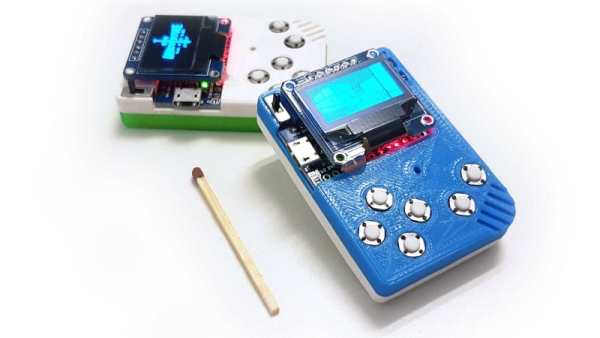
The Arduboy — which we originally looked at back in 2014 — is a handheld gaming console in a somewhat Gameboy-like form factor. Normally a credit-card sized PCB hosts all the components, including a microcontroller, display, and buttons. Each has a predictable footprint and placement so they can simply be wired together with hookup wire, if you don’t mind a messy result.
Here the print itself has all the holes ready-created for the components, and the path of the wires has a resemblance to the sweeping traces of older hand-laid PCBs. The result is very effective way to take common components — and Arduino pro micro board for the uC, an OLED breakout board, and some buttons — and combine them into a robust package. This technique of using 3D prints as a combination of enclosure and substrate for components and wiring has an application far beyond handheld gaming. We look forward to seeing more like it.
Source: 3D PRINTING FOR WIRE PATHS YIELDS AN ARDUBOY MINUS THE PCB
- What is the main innovation of the 3DPCBoy?
The project uses 3D printing to create a case with pre-made channels for wires, acting as both an enclosure and a substrate. - How does this design compare to a traditional PCB?
It offers the effect of a PCB without the actual circuit board by using routed wire paths within the print. - Can this method be applied to other projects?
Yes, this technique has applications far beyond handheld gaming for combining common components. - What makes the construction process quick and cheap?
Using standard components like the Arduino Pro Micro and an OLED breakout avoids expensive custom PCB fabrication. - What does the wiring path resemble?
The wire paths have a resemblance to the sweeping traces of older hand-laid PCBs. - Is the result considered robust?
Yes, the article describes the combination of components into a robust package as very effective. - What form factor does the Arduboy typically use?
The Arduboy is a handheld gaming console in a somewhat Gameboy-like form factor. - Why might someone choose this over point-to-point wiring?
This solution provides a cleaner alternative to a messy rats-nest of point-to-point wiring.
