
Summary of 3D PRINTED ROBOT WANTS TO BE YOUR PET
Snoopy is an open-source, beginner-friendly robot project using an Arduino running ROS2, housed in a 3D-printed body. Built on the Kaia.ai platform layered over ROS2, it aims to simplify robot development with a short parts list that can be sourced from common junk-drawer components. The project focuses on keeping designs simple, learning from the creator’s previous, overly complex Kiddo project. Snoopy provides printed frames and electronics guidance to help newcomers get started without deep real-time OS expertise.
Parts used in the Snoopy:
- Arduino (for running ROS2)
- 3D-printed frame/body parts
- Electronics to connect Arduino to motors and sensors
- Motors or actuators (for movement)
- Sensors (unspecified, for robot interaction)
- Wiring and connectors
- Power supply/battery
Robots are cool. Robots you build yourself are cooler, especially ones that use stuff you have lying around already. Snoopy is a new open-source robot that uses an Arduino as a brain but with a 3D printed body and a short list of parts that can probably be sourced from the junk drawer. It’s still being developed, but it looks like a cool project heading in the right direction to produce an interesting robot.
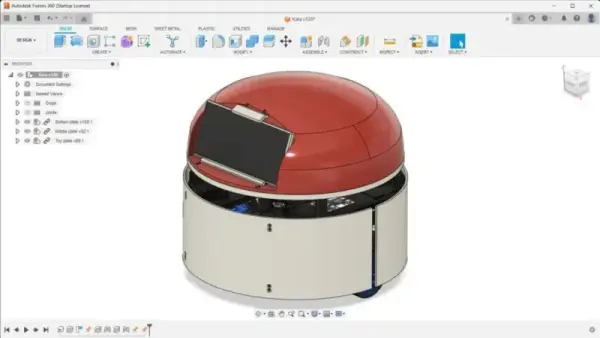
It’s based on a new robot software platform called Kaia.ai that is built on top of the Robot Operating System 2 (ROS2), but with a more friendly and beginner-focused interface. Currently, the Snoopy project includes enough to get up and running with a printed frame and the electronics to install an Arduino running ROS2 that controls it. That’s an excellent place to start if you want to get into robotics, but without diving straight into the technical challenges of working with real-time operating systems.
It is also interesting that the previous project from the creator (called Kiddo) fell into the complexity trap, where you keep adding features and create an overly complex design that is a pain to build. Hopefully the designers have learned from Kiddo and will keep Snoopy simple.
We’ve covered plenty of other robot projects here at Hackaday, from ones that venture into nuclear reactors to ones that write your thank-you notes for you or give you hugs. We’ve even looked at how to give your robots a personality. Combine all those together with Snoopy and you could build a hugging, compassionate robot that has nice handwriting and can repair a nuclear reactor. And if you do, write it up and send it to our tips line!
Source: 3D PRINTED ROBOT WANTS TO BE YOUR PET
- What is Snoopy?
Snoopy is an open-source robot project with a 3D-printed body and an Arduino running ROS2 via the Kaia.ai platform. - What software does Snoopy use?
Snoopy uses Kaia.ai built on top of Robot Operating System 2 (ROS2). - Can Snoopy be built with common parts?
Yes; it uses a short parts list that can likely be sourced from junk-drawer components. - Is Snoopy suitable for beginners?
Yes; it focuses on simplicity and provides printed frames and electronics guidance to get started without deep real-time OS expertise. - What role does the Arduino play in Snoopy?
The Arduino runs ROS2 and serves as the robot's brain to control electronics and movement. - Does Snoopy include designs for a 3D-printed frame?
Yes; the project includes enough to get up and running with a printed frame. - How does Snoopy address past design complexity?
The designers aim to keep Snoopy simple, learning from the previous Kiddo project that became overly complex. - Can Snoopy be extended with personalities or extra features?
Yes; the article suggests combining Snoopy with other robot projects to add personality or additional capabilities.
