
Summary of 3D PRINTED JIG MAKES CUSTOM SPRINGS A SNAP
This article highlights a 3D-printed "Spring Factory" jig by Vincent Baillet, designed to simplify custom spring creation. Unlike manual winding which relies on eyeballing spacing, this tool uses a threaded mandrel to ensure consistent coil pitch and identical springs. It works with piano wire ranging from 0.8 to 1.2 mm. While the device is limited to a specific diameter (approx. 9 mm), it offers a professional result faster than traditional methods for projects requiring multiple matching springs.
Parts used in the Spring Factory:
- Stiff metal wire
- Threaded mandrel
- 3D printed parts
- Piano wire (0.8 to 1.2 mm)
We’ve often heard it said that springs come in in all shapes and sizes…except for the one you need. In light of this, the hardware hacker would do well to keep the tools and knowledge required to make a custom spring close at hand when building something that moves. Luckily, all it really take is some stiff metal wire, a rod, and patience.
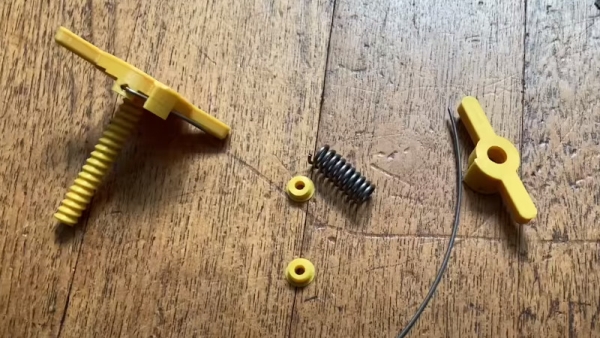
Unless you’ve got a 3D printer, that is. In which case, we’d suggest you print out this very clever “Spring Factory” designed by [Vincent Baillet]. The simple tool, consisting of just two parts, makes it easier and faster to make consistent DIY springs when compared to traditional methods. Rather than trying to eyeball the spacing of the coil as you wind the wire around the mandrel, this design does it for you.
As seen in the video, springs made with this tool look very professional. Not only does the threaded mandrel keep the spacing between coils even, it also makes sure all the springs you produce are identical. This can be especially important with projects that need to use multiple matching springs. [Vincent] says his handy tool works with piano wire from 0.8 to 1.2 mm, and slightly thicker if plain steel.
Of course, the obvious flaw in a tool like this is that it can only be used to make springs of a specific diameter. Changing the length is easy enough, just use more or less wire. But to make a thinner or thicker spring, you’d need a different size of mandrel. It seems that [Vincent] has only released the gadget in this approximately 9 mm diameter so far, but here’s hoping a few more sizes get added to the mix before too long.
Looking for something a bit more advanced? This Arduino-powered wire bender is capable of making some very impressive custom springs, among other things.
Source: 3D PRINTED JIG MAKES CUSTOM SPRINGS A SNAP
- What is the main advantage of the Spring Factory over traditional methods?
The tool ensures even spacing between coils and produces identical springs without needing to eyeball the process. - Can I use plain steel wire with this tool?
Yes, it works with slightly thicker plain steel wire in addition to piano wire. - How do I change the length of the spring?
You simply use more or less wire to adjust the length. - Does the tool work with any wire diameter?
No, it is designed specifically for piano wire from 0.8 to 1.2 mm and slightly thicker plain steel. - Is it possible to make springs of different diameters with one tool?
No, you need a different size mandrel to make thinner or thicker springs. - What is the current diameter limitation of the released gadget?
The gadget has been released with an approximately 9 mm diameter mandrel. - Do I need a 3D printer to use this design?
Yes, the article suggests printing out the tool if you have a 3D printer. - Why are matching springs important according to the text?
Matching springs are especially important for projects that require multiple identical components.
