
Summary of USB Adaptive Charger (2.7A per port) with Wattmeter
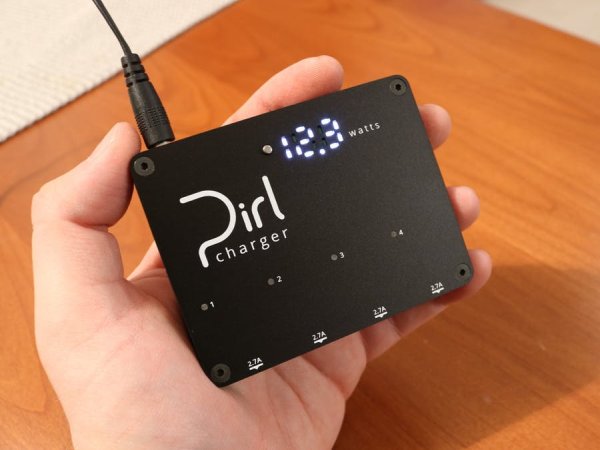
The Pirl Charger addresses poor quality aftermarket chargers that damage devices with high noise and ripple. It accepts 7V–17V DC input from various sources, stepping down to a stable 5V output. Capable of delivering 10.8A across four ports without throttling, it features independent circuitry for each port with protections against overheating, shorts, and reverse polarity. An integrated wattmeter monitors power usage, while the enclosure combines anodized aluminum plates with FR4 layers for durability.
Parts used in the Pirl Charger:
- AC/DC adapter
- Car adapter
- Lead-acid batteries
- DC-output solar panels
- Lithium-ion battery packs (2S, 3S, and 4S)
- Anodized aluminum top plates
- Anodized aluminum bottom plates
- FR4 middle layers
- Integrated wattmeter
- Overheating protection circuitry
- Static discharge protection circuitry
- Short circuit protection circuitry
- Reverse polarity protection circuitry
Story
Why:
We built the Pirl Charger because we were unhappy with the quality of existing chargers. Few consumers know they gradually ruin their expensive devices by using poor quality chargers that deliver high noise, high ripple energy. Every consumer device comes with a charger, and those are usually well-built, but they usually have only one port, and if you lose it, you usually buy an aftermarket charger. However, replacement chargers range widely in quality, and most people don’t know.
How it works:
It works by taking any DC input between 7V to 17V, from an AC/DC adapter or car adapter. It can be used anywhere with wall outlets, car power ports, lead-acid batteries, DC-output solar panels, and lithium-ion battery packs (2S, 3S, and 4S).
It then drops the voltage down to 5V and intelligently adapts to match the maximum current the device being charged would accept. We believe it is the most powerful 4-port USB charger at 10.8A. No device is throttled when every port is in use.
Robustness:
We wanted a robust device so each USB port is almost electrically independent and contains robust circuitry with overheating, static discharge, short circuit, and reverse polarity protections.
Wattmeter:
It has an integrated wattmeter so you don’t need a multimeter to know how much power you are drawing devices.
Case:
Mechanically, it is built with anodized aluminum top and bottom plates, and the middle layers are made of FR4.
Specs:
You can see the rest of the specs at pirlcharger.com.
Teardown:
We have received teardown review by Lygte.
Read more: USB Adaptive Charger (2.7A per port) with Wattmeter
- Why was the Pirl Charger built?
It was built because consumers are unhappy with existing charger quality that delivers high noise and ripple energy. - What voltage range does the device accept as input?
It takes any DC input between 7V to 17V. - Can I use this charger with solar panels?
Yes, it can be used with DC-output solar panels. - How much total current does the charger provide?
It provides a maximum of 10.8A across its four ports. - Does the charger throttle power when all ports are in use?
No, no device is throttled when every port is in use. - What safety protections are included for each USB port?
Each port has protections against overheating, static discharge, short circuits, and reverse polarity. - Do I need a multimeter to check power usage?
No, the integrated wattmeter shows how much power devices are drawing. - What materials are used for the case construction?
The case uses anodized aluminum for top and bottom plates with FR4 for the middle layers. - Is there a teardown review available?
Yes, a teardown review by Lygte has been received.
