
Summary of Tiny DDS – Open source DDS generator
This article describes an open-source, low-profile Direct Digital Synthesis (DDS) generator designed for small-scale use. The project utilizes a smart TFT module, AD9834 chip, and LM7171 fast amplifier to produce signals ranging from 0 to 1MHz with amplitudes between 1Vpp and 10Vpp. It operates safely on 12V DC, offering a cost-effective alternative to expensive FPGA or eBay modules while ensuring ease of use.
Parts used in the Tiny DDS Generator:
- Smart TFT module
- AD9834 chip
- LM7171 fast amplifier
This project is an open source (hardware & software) DDS generator, based on: smart TFT module, AD9834, LM7171 fast amplifier. The homemade function generator is a quite common project on the internet. We can find different ways to do it:
– The quick & dirty way based on a DDS module bought on eBay
– The analog version based on a MAX038 / XR2206
– The clean way based on a FPGA and a fast DAC (e.g. http://www.circuitben.net/node/14)
– The software way (e.g. Arduino + R/2R DAC)
From my side, I wanted a small one which could fits my needs without being too expensive. According to me, such generator should at least:
– Be easy to use
– Output a signal from 1Vpp to 10Vpp (+/-5V), from 0 to 1MHz
– Have a low profile
– Without electric hazard (shall work on a 12V DC)
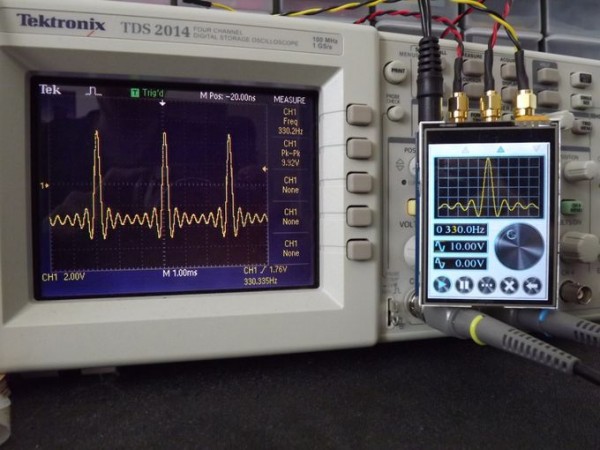
For more detail: Tiny DDS – Open source DDS generator
- What is the main purpose of this project?
To create an open-source hardware and software DDS generator. - Can this generator operate without electric hazards?
Yes, it works on a safe 12V DC power supply. - What is the frequency range of the output signal?
The device outputs signals from 0 to 1MHz. - How does the amplitude vary?
The output signal ranges from 1Vpp to 10Vpp, which equals +/-5V. - Is this project considered expensive?
No, the design aims to fit needs without being too expensive. - What makes this generator low profile?
The design was specifically chosen to be small and low profile. - Does this project require an FPGA?
No, it uses a smart TFT module and AD9834 instead of an FPGA.
