
Summary of TI-83 GETS CIRCUITPYTHON UPGRADE
This article discusses the TI-Python peripheral, which enables Python programming on the TI-83 Premium CE calculator by offloading processing to an external Atmel SAMD21E18A-U chip running CircuitPython. Users can hack this setup to replace the official module with compatible boards like the Adafruit Trinket M0 or Arduino Zero. This project transforms the calculator into a thin client, opening possibilities for advanced applications like games and social media clients despite the device's limited native power.
Parts used in the TI-83 Python Upgrade:
- TI-83 Premium CE calculator
- TI-Python peripheral
- Atmel SAMD21E18A-U chip
- CircuitPython firmware
- Adafruit Trinket M0 board
- Arduino Zero board
Graphing calculators are an interesting niche market these days. They’re relatively underpowered, and usually come with cheap, low resolution screens to boot. They remain viable almost solely due to their use in education and the fact that their limited connectivity makes them suitable for use in exams. The market is starting to hot up, though – and TI have recently been doing some interesting work with Python on their TI-83.
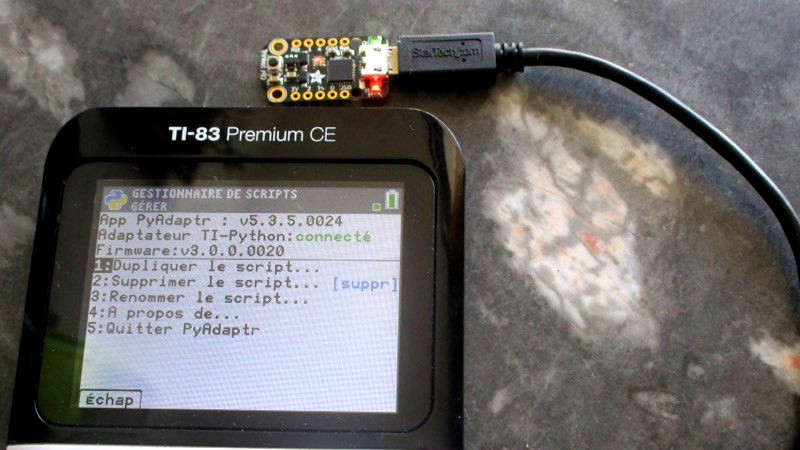
Rumor has it that TI have been unable to get Python to run viably directly on the TI-83 Premium CE. This led to the development of the TI-Python peripheral, which plugs into the calculator’s expansion port. This allows users to program in Python, with the TI-Python doing the work and the calculator essentially acting as a thin client. The chip inside is an Atmel SAMD21E18A-U, and is apparently running Adafruit’s CircuitPython platform.
This discovery led to further digging, of course. With some hacking, the TI-Python can instead be replaced with other boards based on Atmel SAMD21 chips. For those of you that aren’t in Atmel’s sales team, that means it’s possible to use things like the Adafruit Trinket M0 and the Arduino Zero instead, when flashed with the appropriate CircuitPython firmware. It’s a tricky business, involving USB IDs and some other hacks, but it’s nothing that can’t be achieved in a few hours or so.
This is a hack in its early days, so it’s currently more about building a platform at this stage rather then building fully-fledged projects just yet. We’re fully expecting to see Twitter clients and multiplayer games hit the TI-83 platform before long, of course. When you’ve done it, chuck us a link on the tip line.
Source: TI-83 GETS CIRCUITPYTHON UPGRADE
- Why is the TI-Python peripheral needed?
Rumors suggest TI could not run Python viably directly on the TI-83 Premium CE, so the peripheral allows users to program in Python while the calculator acts as a thin client. - What chip powers the TI-Python module?
The module contains an Atmel SAMD21E18A-U chip that runs Adafruit’s CircuitPython platform. - Can other boards replace the official TI-Python?
Yes, users can replace the TI-Python with boards based on Atmel SAMD21 chips like the Adafruit Trinket M0 or Arduino Zero. - What software must be flashed onto replacement boards?
Replacement boards require the appropriate CircuitPython firmware to function within the calculator system. - Is replacing the TI-Python difficult?
It is a tricky business involving USB IDs and hacks, but it can be achieved in a few hours. - What are the expected future projects for this platform?
The author expects Twitter clients and multiplayer games to appear on the TI-83 platform soon. - What makes graphing calculators viable for exams?
Their limited connectivity makes them suitable for use in exams despite being underpowered with low resolution screens. - How does the TI-Python handle processing tasks?
The TI-Python peripheral does the work while the calculator essentially acts as a thin client.
