
Summary of THREE QUANTUM COMPUTER COMPONENTS INTEGRATED ON ONE CHIP
Scientists from the University of Stuttgart and KIT successfully integrated a single-photon source, beamsplitters, and detectors onto a single gallium arsenide chip. This experiment demonstrates the feasibility of scalable, photon-based quantum information processing by overcoming previous challenges regarding laser proximity to detectors.
Parts used in the Quantum Computer Chip Project:
- Single-photon source
- Beamsplitters
- Single-photon detectors
- Gallium arsenide platform
- Quantum dots
- Optical logic circuits
- Superconducting nanowires
- Photonic waveguide
Scientists at the University of Stuttgart and the KIT succeed in important further development on the way to quantum computers.
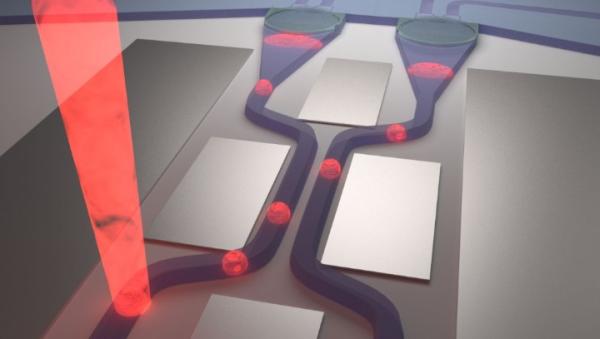
Quantum computers one day should be able to solve certain computing problems much faster than a classical computer. One of the most promising approaches is based on the utilization of single photons to carry and process quantum information. Scientists of the University of Stuttgart and the Karlsruhe Institute of Technology (KIT)were now able to integrate three necessary main components (single-photon source, beamsplitters and single-photon detectors) on a single chip and operate it on the single-photon level. This experiment demonstrates the functionality of the basic components for a scalable system for photon-based quantum information processes. The results got published in Nano Letters.
In contrast to the widespread silicon technology, the experiment was implemented on a gallium arsenide (GaAs) platform, allowing the direct integration of nanometer-sized structures, called quantum dots (QDs), which can serve as efficient on-demand sources of single photons. In addition, GaAs allows guiding these single photons to optical logic circuits and to special on-chip detectors made of superconducting nanowires. In the experiment, single photons emitted by an optically pumped quantum dot were guided inside a photonic waveguide and divided by an on-chip beamsplitter into two waveguide-arms, each equipped with a detector.
One of the challenges so far in this type of fully on-chip experiment was the close proximity of the excitation laser to the on-chip detectors”, explains Mario Schwartz.
The PhD student from the Institute of Semiconductor Optics and Functional Interfaces (IHFG), University of Stuttgart, was working over the last years on the realization of a proof-of-principle experiment to show the feasibility of combining all main components on one single photonic chip. The project was realized in close collaboration with the PhD student Ekkehart Schmidt from the KIT, who is an expert for the design and implementation of the on-chip detectors.
Read more: THREE QUANTUM COMPUTER COMPONENTS INTEGRATED ON ONE CHIP
- What components were integrated on a single chip?
The project integrated a single-photon source, beamsplitters, and single-photon detectors. - Which material platform was used instead of silicon?
A gallium arsenide platform was used for the experiment. - How are single photons generated in this setup?
Single photons are emitted by an optically pumped quantum dot. - What allows direct integration of nanometer-sized structures?
The gallium arsenide platform allows the direct integration of quantum dots. - How do the detectors work in this system?
The detectors are made of superconducting nanowires located on the chip. - What challenge did scientists overcome with this experiment?
They overcame the challenge of the close proximity of the excitation laser to the on-chip detectors. - Who collaborated on the design of the on-chip detectors?
Ekkehart Schmidt from the Karlsruhe Institute of Technology designed and implemented the detectors. - Where were the results published?
The results were published in Nano Letters.
