
Summary of TEC MICROSYSTEMS INTRODUCES NEW THERMOELECTRIC COOLERS WITH ALUMINUM PLATES
TEC Microsystems' 1MA10 Series thermoelectric coolers use bare aluminum plates instead of ceramic, offering easier machining, suitable thermal conductivity, and matching CTE with aluminum heatsinks—beneficial for PCR and long-term temperature cycling. Combining classical bulk TEC technology with high-density pellet placement yields up to 30 W/cm2 cooling power density, enabling TECs four times smaller without losing performance. This allows over 100 W Qmax in a 20x20 mm package versus traditional 40x40 or 50x50 mm devices.
Parts used in the 1MA10 Series Thermoelectric Cooler Project:
- 1MA10 thermoelectric cooler units
- Aluminum plates (bare metal)
- High-density thermoelectric pellets
- Aluminum heatsinks
- Bulk thermoelectric cooler (TEC) structure
TEC Microsystems introduces the new 1MA10 Series of thermoelectric coolers, with aluminum plates instead of ceramics.
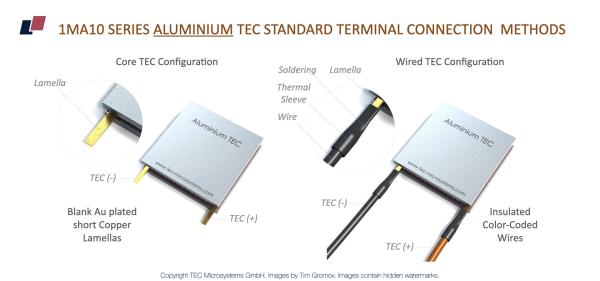
All 1MA10 thermoelectric coolers have bare metal, aluminum plates instead of ceramics. Aluminum instead of ceramics is the key approach in TEC manufacturing. According to the company, aluminum is easy to machine, it has suitable thermal conductivity than ceramics, and it matches ideally by CTE with Aluminum heatsinks. An ideal combination for PCR and any application with long-term temperature cycling.
1MA10 TECs have the combination of classical bulk thermoelectric coolers technology with advanced high-density (HD) pellets placement. This combination allows reaching a 30W/cm2 cooling power density and creating 4x times smaller TEC solutions without compromises in cooling performance. More than 100W of TEC cooling capacity (Qmax) is possible now on just 20x20mm2 size instead of traditional 40x40mm2 or 50x50mm2.
Read more: TEC MICROSYSTEMS INTRODUCES NEW THERMOELECTRIC COOLERS WITH ALUMINUM PLATES
- What is different about the 1MA10 Series compared to traditional TECs?
The 1MA10 Series uses bare aluminum plates instead of ceramic plates and employs high-density pellet placement combined with classical bulk TEC technology. - Why does TEC Microsystems use aluminum plates?
Aluminum is easy to machine, has suitable thermal conductivity, and matches coefficient of thermal expansion with aluminum heatsinks. - What cooling power density does the 1MA10 achieve?
The 1MA10 reaches up to 30 W per cm2 cooling power density. - How does pellet placement contribute to performance?
High-density pellet placement enables higher cooling power density and allows creating much smaller TEC solutions without compromising performance. - What Qmax cooling capacity is possible with the 1MA10?
More than 100 W of TEC cooling capacity (Qmax) is possible in a 20x20 mm2 unit. - How much smaller can 1MA10 TECs be compared to traditional designs?
The 1MA10 allows creating TEC solutions up to four times smaller than traditional units. - What applications benefit from aluminum plate TECs?
Applications with long-term temperature cycling, such as PCR, benefit from aluminum plate TECs.
