
Summary of STORM CLOUD LAMP BRINGS THE WEATHER INSIDE
This article describes [Michael Pick]'s "Storm Cloud" lamp, a creative hacker build inspired by nature. The project combines simple electronics with fiberglass crafting to create an interactive cloud that displays soft rainbows and dramatic storm effects with synchronized sound.
Parts used in the Storm Cloud Lamp:
- Arduino Uno
- MP3 shield
- WS2801 LEDs
- RF keyfob
- Voice synth
- Cardboard
- Tape
- Fiberglass
- Bolts
- Spray adhesive
- Cotton wool or polyfill stuffing
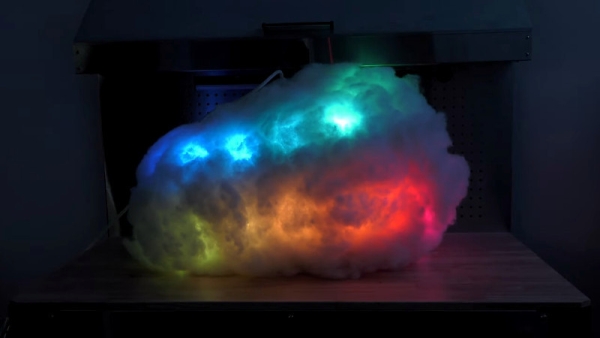
The humble lamp is a common build for a hacker looking to express themselves creatively. Often, nature can serve as an inspiration, as was the case for [Michael Pick]’s Storm Cloud. (Video, embedded below.)
Electronically, the build is straightforward, consisting of an Arduino Uno, an MP3 shield, and a string of WS2801 LEDs. These are driven slightly differently than the more-common WS2812B type, but Adafruit libraries make it easy for even the beginner. There’s also an RF keyfob fitted for remote control of the device, and a voice synth that serves as a user interface.
The video also covers the construction of the body of the lamp. Cardboard forms are created, then covered in tape to create a rough 3D ovaloid shape. This mold is then fiberglassed to create two shells, which are later joined together with bolts. This allows the LEDs and electronics to be neatly mounted inside. Spray adhesive is then used to affix what appears to be cotton wool or polyfill stuffing to the outside to create the cloud effect.
The final result is rather aesthetically pleasing. There’s the usual soft-glowing rainbows as you’d expect, but the real highlight is storm mode, which causes flickers of lighting to scatter across the surface of the cloud. The accompanying sound effects from the MP3 shield help add to the drama.
We’ve seen other takes on a cloud lamp before, too. Video after the break.
Source: STORM CLOUD LAMP BRINGS THE WEATHER INSIDE
-
What inspires the design of this lamp?
Nature serves as the inspiration for the Storm Cloud lamp. -
Which microcontroller is used in the build?
The build consists of an Arduino Uno. -
How are the WS2801 LEDs driven?
Adafruit libraries make it easy to drive these LEDs even for beginners. -
What component allows remote control of the device?
An RF keyfob is fitted for remote control of the device. -
How is the body mold created?
Cardboard forms are created and covered in tape to form a rough 3D ovaloid shape. -
What material is used to create the two shells?
The mold is fiberglassed to create two shells which are joined together with bolts. -
How is the cloud effect achieved on the outside?
Spray adhesive is used to affix cotton wool or polyfill stuffing to the outside. -
What happens during storm mode?
Storm mode causes flickers of lighting to scatter across the surface of the cloud.
