
Summary of SPINNING UP A NEW LAUNDRY MONITOR
This project upgrades a laundry-notification system by replacing a vibration sensor with split-core current transformers at the breaker panel to detect when washer and dryer are running. The transformers feed millivolt signals via 3.5mm cables to an ESP32 in a 3D-printed enclosure, which integrates with home assistants to announce when laundry is done. The Python logic suppresses notifications during long self-clean cycles.
Parts used in the Laundry Monitor:
- Split-core current transformers
- 3.5mm cables
- ESP32 microcontroller
- 3D-printed enclosure (box)
- Breaker panel/wiring (for running conductor through transformers)
- Home assistant devices (for announcements)
- Python script/software for event handling
For all that modern washers and dryers do, they don’t let you know when they’re finished. Or they do, but it’s only a short victory song that plays once and can be easy to miss. What most of us need is a gentle reminder that there’s damp laundry festering in the washer, or fresh laundry in the dryer getting wrinkly.
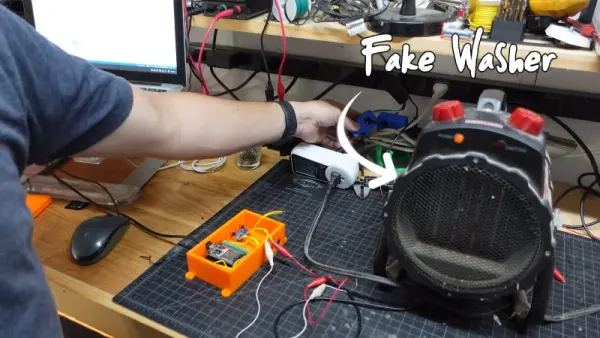
This laundry monitor from [Sparks and Code] is version 2.0. The first version was working fine, but it was based on vibration (or lack thereof). Fast forward a few years, and [Sparks and Code] got a modern pair that’s so finely tuned, it doesn’t produce enough vibration to register. Back to the drawing board [Sparks and Code] went, and eventually came up with version 2.0.
Now, [Sparks and Code] is detecting whether the machines are on using a pair of split-core transformers to monitor power at the breaker box. With these, you just run the wire through the hole, and it gives the relative mV value going through the wire on a 3.5mm cable. Those cables are connected to an ESP32 inside the 3D-printed box, which is mounted above the cabinet door. Since [Sparks and Code] already has home assistants all over the house, it was easy to integrate and have them all play the message ‘please flip the laundry’.
Once this project was all buttoned up, they thought of one issue — the self-cleaning cycle. Since it takes about four hours, they like to run it overnight. You can see the problem here — no one wants to hear Alexa at 3AM. Fortunately, [Sparks and Code] was able to adjust the Python script to ignore these events. Be sure to check out the build video after the break.
If only the dryer could empty itself and fold the clothes. Oh wait, there’s a robot for that.
Source: SPINNING UP A NEW LAUNDRY MONITOR
- How does the upgraded laundry monitor detect if machines are on?
It uses split-core current transformers on the breaker-panel wiring to measure relative millivolt signals through 3.5mm cables to an ESP32. - Why was vibration sensing replaced in version 2.0?
The new washer is so finely tuned that it does not produce enough vibration to register, so vibration sensing became unreliable. - What hardware connects the current transformers to the monitoring system?
The transformers output millivolt values on 3.5mm cables that connect to an ESP32 inside a 3D-printed box. - How are notifications delivered when a cycle finishes?
The ESP32 integrates with existing home assistants to play the message please flip the laundry. - How does the system avoid waking people during a self-clean cycle?
The Python script was adjusted to ignore long self-clean events, preventing notifications at night. - Where is the monitoring enclosure mounted?
The 3D-printed box with the ESP32 is mounted above the cabinet door. - Does the project require access to the breaker panel?
Yes, the split-core transformers are installed at the breaker panel by running the machine conductor through the transformer hole. - Is custom software used in this project?
Yes, a Python script handles event logic and integrates with home assistants.
