
Summary of SOM PROVIDES ARM CORTEX-A7 PERFORMANCE IN QFN-STYLE PACKAGE
Direct Insight and Ka-Ro Electronics released a QSMP solder-down System on Module using the STMicro ST32M1 family (single/dual 650 MHz ARM Cortex-A7 plus 200 MHz Cortex-M4). The 27 mm square, 2.3 mm high QFN-style module supports up to 512 MB DDR3L, up to 4 GB eMMC, offers a 3D GPU, secure boot and crypto engines, broad interfaces, improved thermal/EMI behavior, and can operate across industrial temperature ranges; its QFN-like solder-down package simplifies routing, inspection, and assembly.
Parts used in the QSMP Solder-down Module:
- STMicro ST32M1 family processor (single or dual 650 MHz ARM Cortex-A7)
- ARM Cortex-M4 coprocessor (200 MHz)
- Up to 512 MB DDR3L RAM
- Up to 4 GB eMMC Flash
- 3D GPU (integrated in ST32M1)
- Crypto engine (AES/TDES/SHA, integrated in ST32M1)
- QFN-type solder-down package with 1 mm pitch and 100 edge-located pads
- Base plane/ground pad (integrated into package for thermal conduction and EMI)
Direct Insight has introduced a QSMP Solder-down module featuring the STMicro ST32M1 single/dual core ARM Cortex-A7 processor. The module has been manufactured by the Direct Insight’s partner, Aachen-based Ka-Ro Electronics.
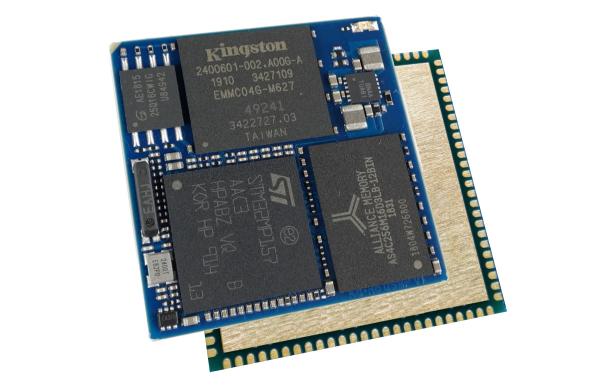
The SOM has been built around an ST32M1 family processor that is powered by a single or dual 650MHz ARM Cortex-A7 core, which is supported by a separate ARM Cortex-M4 operting at 200MHz with up to 512MB of DDR3L RAM and up to 4GB eMMC Flash. The ST chip also offers a wide range of interfaces. The chip has been developed to provide low power operation, combined with security features and high-performance. To boost performance, the ST32M157C can offer a powerful 3D GPU and the integrated security features include secure boot and an AES/TDES/SHA crypto-engine.
The QSMP SoM measures 27mm square and is only 2.3mm high. It has been manufactured in a solder-down package that features a QFN-type pin-out that is based on a 1mm pitch with 100 edge-located pads. The SoM has been built this way to assist inspection and simplify routing. It even permits a two-layer baseboard and a base plane. The ground plane design helps the modules ‘float’ into position during reflow, unlike a BGA which requires X-Ray inspection to ensure full connectivity. The QS solder-down modules are small enough to prevent warping. The package’s design also improves thermal efficiency and EMI performance with the base functioning as both a ground pad and a thermal conductor. The modules can operate across the industrial temperature range of -40 or -25 to +85degC.
Read more: SOM PROVIDES ARM CORTEX-A7 PERFORMANCE IN QFN-STYLE PACKAGE
- What processor does the QSMP SoM use?
The module uses the STMicro ST32M1 family processor with single or dual 650 MHz ARM Cortex-A7 cores. - Does the module include a microcontroller core?
Yes, it includes a separate ARM Cortex-M4 operating at 200 MHz. - How much RAM and Flash does the SoM support?
It supports up to 512 MB of DDR3L RAM and up to 4 GB of eMMC Flash. - What security features are integrated?
The ST32M1 provides secure boot and an AES/TDES/SHA crypto-engine. - What are the module physical dimensions?
The QSMP SoM measures 27 mm square and is 2.3 mm high. - What package type does the module use and why?
It uses a QFN-type solder-down package with 1 mm pitch and 100 edge-located pads to simplify routing and inspection and allow two-layer baseboards. - How does the package improve assembly and inspection?
The solder-down QFN-style design helps the module float into position during reflow, avoids the need for X-Ray inspection, and prevents warping. - What thermal and EMI benefits does the package provide?
The base functions as a ground pad and thermal conductor, improving thermal efficiency and EMI performance. - What operating temperature range is supported?
The modules can operate across industrial temperature ranges of -40 or -25 to +85 degrees Celsius as stated.
