
Summary of Smart Tank – Arduino Powered Aquarium
This article outlines the development of an Automatic Aquarium System (AAS) designed to simplify fish tank maintenance for beginners and experts. The project aims to automate critical functions like lighting, feeding, CO2 regulation, and filtration while monitoring water quality parameters such as pH and temperature. By using an Arduino-based approach, the system addresses common challenges like forgetfulness and lack of time, allowing users to manage their tanks remotely or on a schedule without needing advanced technical skills.
Parts used in the Automatic Aquarium System:
- Arduino
- Lights
- Food dispenser
- CO2 system
- Filter
- Temperature sensor
- pH sensor
- Water level sensor
- Ammonia sensor
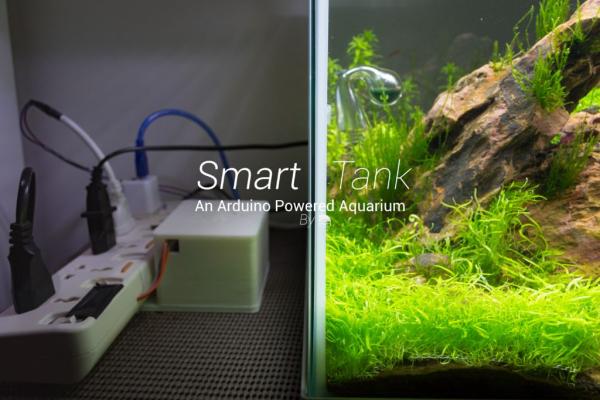
It can be a daunting experience buying, setting up and maintaining (or even thinking about) a fish tank and if they have the time needed for this hobby to keep their new friends alive. I have recently brought my first Aqurium and i personally went through the thought process of: Smart Tank – Arduino Powered Aquarium:
Smart Tank – Arduino Powered Aquarium:
- Have I got enough time for the tank?
- Have I got enough Knowledge to keep the tank and the fish alive?
And then the user begins to do subtle research on the topic and discover things like diseases, Co2 levels/PH levels, water hardness, the duration for lighting and types of filters. All this new information is like a wall that the user has to overcome to have a functional Aquarium, this wall can turn people away from the enjoyable hobby very quickly. I personally felt I wasn’t up to the responsibility of these creatures due to my forgetful nature. On top of that, who will keep care of the fish when they are not there? For a day, a week, a holiday?
The AAS, short for Automatic Aqurium System, is a work in process mighty project that aims to be the step ladder over the wall for new users.
But what about people that have Aquariums:
The market is still there. I know multiple friends who have over 6 tanks that are used for both breeding grounds and to look nice. They too struggle with keeping care of them when they are not there, keeping care of and monitoring all 6 tanks and when they too are busy, ensuring it is maintained.
I definitely believe all levels of Aquarists can benefit from this idea, and I set about to make it.
Step 1: AAS – Solution
The solution:
I am going to split this part into two parts, what I have achieved in the time frame I set out for myself and what I want to make during the summer (this will get updated with the new changes).
I aim to design a product that can control the main parts of an aquarium by itself on using both time and a predicted function.
So what does that mean?
The main parts of an aquarium that i have identified are:
- Lights
- Food
- Co2 system (if they have it)
- Filter
- Any other devices the user has
So what functions do I aim for it to have:
- Turn on and off the components that they have
- Feed the Fish
- Be able to record data such as temperature, PH and water levels (ammonia levels and more)
- For the user to be able to easily understand the results
So how do I set about achieving this?
My thought process:
For this project, I wanted to focus on the core of the project so I could, in the future, build upon it. I decided that the main part of this was to be able to turn on and off the user’s devices on a timely base.
How would i do this?
Idea #1: Solder all the components to one main system and control it from there.
Pros:
- Direct control over all devices
- Endless amount of devices
Cons
- The user would need to know how to solder!?
- The whole device could lack power/current as it would be unevenly distributed.
- What is the main goal of the Automatic Aquarium System?
The system aims to control the main parts of an aquarium by itself using time and predicted functions. - How does the system help new users overcome the learning wall?
It acts as a step ladder over the wall of complex information regarding diseases, CO2 levels, and maintenance. - Can the system monitor water quality parameters?
Yes, it can record data such as temperature, pH, water levels, and ammonia levels. - What components can the system turn on and off automatically?
It controls lights, food dispensers, CO2 systems, filters, and other user devices. - Why did the author choose not to solder all components together initially?
Soldering requires user knowledge and could lead to uneven power distribution across the device. - Who can benefit from this automatic aquarium idea?
All levels of aquarists, including those with multiple tanks for breeding or decoration. - What function does the system perform regarding fish feeding?
The system is designed to feed the fish automatically based on a set schedule. - Does the system provide easy-to-understand results for the user?
Yes, one of the aimed functions is to ensure the user can easily understand the recorded results.
