
Summary of SIMPLE ADAPTER BOARD TURNS A USB-C POWER SUPPLY INTO A VARIABLE VOLTAGE SOURCE
The ZY12PDN is a simple STM32-powered USB-C PD trigger board that negotiates USB-C power delivery to provide selectable output voltages (5, 9, 12, 15, 20 V) up to available PD wattage. It uses a push-button to set voltage, has a USB-C connector, header pins, USB-A, and landing pads for screw terminals, and requires a power-up configuration sequence to lock in the chosen mode.
Parts used in the ZY12PDN project:
- STM32 microcontroller
- USB-C connector
- USB-A connector
- Push-button
- Header pins
- Landing pads for screw terminals
- PCB with power delivery controller circuitry (ZY12PDN board)
Being able to turn a USB-C supply to a variable power supply is certainly a big deal for a simple ingenious board like the ZY12PDN board shared by Keneth Finnegan on his twitter handle recently. The ZY12PDN is a simple STM-powered adapter board that turns a USB-C supply to a universal power supply for almost any electronic device.
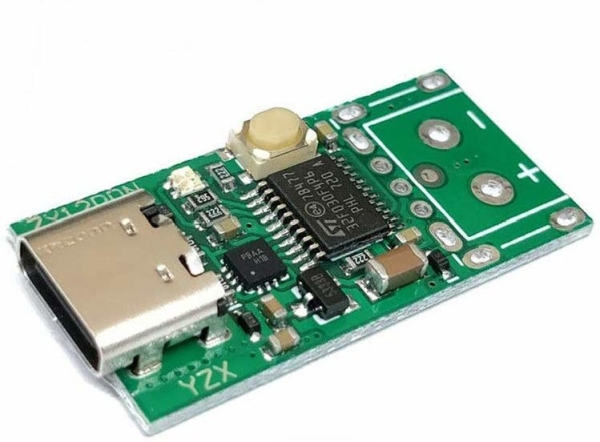
We know that a USB-C, when it comes to power delivery, allows you to negotiate for 5, 9, 12, 15, 20 volts, with supply up to 100W which makes it possible to charge devices like laptops, phones, tablets, but the simplicity with which the ZY12PDN achieves it, brings lot of possibilities to the table.
The ZY12PDN, a USB-C power delivery trigger board uses the USB-C power delivery protocols to negotiate the level of voltage you want. The ZY12PDN has an STM32 microcontroller that helps in negotiating for the PD protocol. It also has, on one of its sides, a USB-C connector and on another side, header pins, USB-A connector and landing patterns for screw terminals.
Unlike some other USB power delivery adapters that need I2C communication for configuration, this power adapter board makes use of a push-button for setting the voltage you want to negotiate. “Finnegan” has created a video, that shows how the device works since the board does not come with any instructions. He explained that the board must first be configured anytime it is powered up with a sequence that helps to program the board, forcing it to stay powered-up in the desired mode. When connected, the USB power delivery uses a separate communication channel that automatically determines which becomes the supply and which the sink after which they negotiate the power profile they want to use in terms of voltage and current limits.
Read more: SIMPLE ADAPTER BOARD TURNS A USB-C POWER SUPPLY INTO A VARIABLE VOLTAGE SOURCE
- What does the ZY12PDN board do?
It uses USB-C power delivery protocols to negotiate and provide selectable output voltages from a USB-C supply. - Which voltages can the ZY12PDN negotiate?
It can negotiate standard USB-C PD voltages such as 5, 9, 12, 15, and 20 volts. - How is the output voltage selected on the ZY12PDN?
The board uses a push-button to set the desired voltage instead of I2C configuration. - Does the ZY12PDN use a microcontroller?
Yes, it uses an STM32 microcontroller to handle the PD negotiation. - What connectors and outputs does the ZY12PDN provide?
It has a USB-C connector, a USB-A connector, header pins, and landing patterns for screw terminals. - Is there any special configuration required for the ZY12PDN?
Yes, the board must be configured at power-up with a sequence to program it to stay powered in the desired mode. - Can the ZY12PDN supply laptop-level power?
It negotiates USB-C PD profiles, which can provide up to the available PD wattage, including levels used by laptops. - Does the ZY12PDN require I2C to set voltages?
No, it does not require I2C; it uses a push-button for configuration.
