
Summary of Signal Conditioners Offer Drop-in Sensor Solutions for Energy-Harvesting Designs
Sensor-signal conditioning ICs provide compact analog-digital hybrids that handle amplification, excitation, compensation, and linearization for sensor-based IoT designs, helping reduce digital complexity and improve analog calibration accuracy versus purely DSP-based approaches. DSP offers flexibility but needs higher-resolution ADCs and more software/memory, while discrete analog solutions can become complex for sensors like bridge types that require differential amplification and tight component matching.
Parts used in the Sensor Signal Conditioning Project:
- Sensor
- Analog-to-digital converter (ADC)
- Digital signal processor (DSP)
- Sensor-signal conditioning IC (from vendors such as Analog Devices, Maxim Integrated, Texas Instruments)
- Amplifier (including differential amplifiers for bridge sensors)
- Digital-to-analog converter (DAC)
- Matched resistors
- Excitation source
Sensor data acquisition underlies many deeply embedded applications and plays a central role in the evolving Internet of Things (IoT). With the trend toward reliance on energy harvesting for power, sensor-based designs require increasingly effective solutions for processing sensor signals efficiently and accurately. Among available alternatives, specialized sensor-signal conditioning ICs such as those from Analog Devices, Maxim Integrated, and Texas Instruments offer a drop-in solution for sensor-signal acquisition.
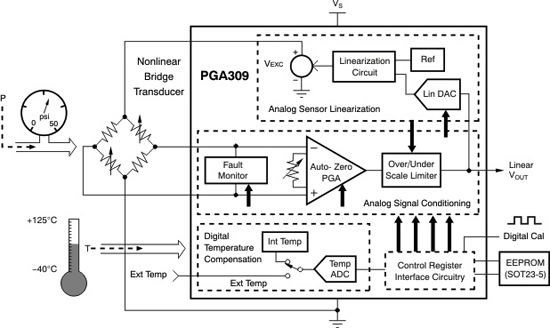
Sensors typically produce small signals that require amplification to boost the dynamic range of the signals, as well as compensation to correct for offset, temperature, and non-linearity response of the sensors themselves (Figure 1). To meet these challenges, designers can turn to a variety of digital and analog methods.
Figure 1: Integrated sensor-signal conditioner ICs combine analog signal paths with digital control features using dedicated digital-analog converters (DACs) to support excitation, compensation, and linearization required in sensor designs (Courtesy of Maxim Integrated).
Sensor-signal processing
Digital signal processing (DSP) methods offer a highly flexible alternative for sensor data acquisition. With a DSP-based approach, amplification, compensation, and correction all occur strictly in the digital domain after signal conversion by an analog-digital converter (ADC). With this approach, however, signals remain within a limited dynamic range, requiring more expensive, higher-resolution ADCs to achieve required precision levels. Furthermore, DSP methods shift design complexity to digital systems, resulting in higher memory requirements and greater software complexity than many deeply embedded applications the IoT can easily support.
In contrast, signal conditioning performed in the analog domain achieves sensor calibration and temperature compensation without incurring the error associated with digital processing of a quantized signal. Yet, discrete solutions can quickly become highly complex with increased sensor complexity and more demanding application requirements. For example, more complex sensor types, such as bridge sensors, require amplifiers be able to amplify the differential-input voltage and reject the common-mode input voltage. Accordingly, engineers working with these types of sensors need to take extra care to ensure use of matched resistors and amplifiers.
For more detail: Signal Conditioners Offer Drop-in Sensor Solutions for Energy-Harvesting Designs
- What advantages do sensor-signal conditioning ICs provide?
They provide drop-in analog-digital hybrid solutions that handle amplification, excitation, compensation, and linearization, reducing digital system complexity. - Can DSP methods handle amplification and compensation for sensors?
Yes; DSP methods perform amplification, compensation, and correction digitally after ADC conversion. - Does DSP-based sensor processing have drawbacks?
Yes; it requires higher-resolution ADCs, shifts complexity to digital systems, and increases memory and software demands. - Why might analog-domain signal conditioning be preferred?
Because it achieves calibration and temperature compensation without the quantization error associated with digital processing. - Do discrete analog solutions have challenges?
Yes; they can become highly complex as sensor complexity increases and application requirements grow. - What special concerns exist for bridge sensors?
Bridge sensors require amplifiers that amplify differential-input voltage, reject common-mode voltage, and necessitate matched resistors and careful amplifier selection. - Which vendors provide specialized sensor-signal conditioning ICs mentioned in the article?
Analog Devices, Maxim Integrated, and Texas Instruments.
