
Summary of SCIENTISTS DEVELOP SAFER LEAD-BASED PEROVSKITE SOLAR CELL STRUCTURE
Researchers from Northern Illinois University and NREL have developed a safer hybrid perovskite solar cell by applying insoluble lead-absorbing films to the front and back of the device. This innovation sequesters 96% of lead leakage during severe damage, addressing toxicity concerns without compromising performance or stability.
Parts used in the Hybrid Perovskite Solar Cell:
- Lead-absorbing films
- Hybrid organic-inorganic lead halide-based material
- Solar cell structure
Researchers at Northern Illinois University and the U.S. Department of Energy’s (DOE) National Renewable Energy Laboratory (NREL) in Golden, Colorado, reported in the journal Nature on a potential breakthrough in the development of hybrid perovskite solar cells.
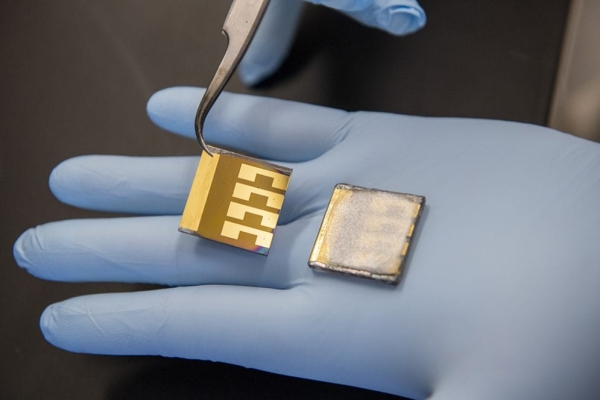
Considered rising stars in the field of solar energy, perovskite solar cells convert light into electricity. They’re potentially cheaper and simpler to produce than traditional silicon-based solar cells and, on a small scale in laboratory settings at least, have demonstrated comparable efficiency levels. But key challenges remain before they can become a competitive commercial technology.
One major challenge is the use of lead. Most top-performing hybrid perovskite solar cells contain water-dissolvable lead, raising concerns over potential leakage from damaged cells.
Led by Tao Xu of NIU and Kai Zhu of NREL, a team of scientists has developed a technique to sequester the lead used to make perovskite solar cells and minimize potential toxic leakage by applying lead-absorbing films to the front and back of the solar cell.
The lead toxicity issue has been one of the most vexing, last-mile challenges in the perovskite solar cell field,” said Xu, an NIU professor of chemistry. “We think we have a highly promising remedy to this problem—and it could be a game-changer.
“In the event of a damaged cell, our device captures the great majority of the lead, preventing it from leaching into groundwater and soils. The films that we use are insoluble in water.
Under conditions of severe solar cell damage in a lab setting, the lead-absorbing films sequestered 96% of lead leakage, the scientists said. Their experiments further indicate the lead-absorbing layers do not negatively impact cell performance or long-term operation stability.
Perovskite solar cells are so named because they use a class of crystal structures similar to that found in the mineral known as perovskite. The perovskite-structured compound within these solar cells is most commonly a hybrid organic-inorganic lead halide-based material.
Read more: SCIENTISTS DEVELOP SAFER LEAD-BASED PEROVSKITE SOLAR CELL STRUCTURE
- How does the new technique minimize lead toxicity?
The team applies lead-absorbing films to the front and back of the solar cell to sequester lead. - What percentage of lead leakage was captured during lab tests?
The lead-absorbing films sequestered 96% of lead leakage under conditions of severe damage. - Does the addition of these films affect cell performance?
No, experiments indicate the layers do not negatively impact cell performance or long-term operation stability. - Why is lead a major challenge in current perovskite cells?
Most top-performing cells contain water-dissolvable lead, raising concerns about leakage into groundwater. - Are the lead-absorbing films soluble in water?
No, the films used are insoluble in water. - What makes perovskite solar cells potentially cheaper than silicon cells?
They are potentially simpler to produce and have demonstrated comparable efficiency levels on a small scale. - Who led the research team developing this technology?
The team was led by Tao Xu of NIU and Kai Zhu of NREL.
