
Summary of RODRIGUEZ — IV CURVE TRACER ON THE CHEAP
This article describes a DIY IV curve tracer named "Slowpoke Rodriguez," built by [Joseph Eoff] using an Arduino Nano, passive components, and a Python/Qt control script. The project optimizes the Nano's 10-bit ADC via oversampling and Timer1 library to achieve higher resolution PWM steps. However, the design is extremely slow, taking minutes to trace five base current values, and is limited to 5 volts and 5 milliamps.
Parts used in Slowpoke Rodriguez:
- Arduino Nano
- Passive components
- Timer1 library
- Python / Qt script
In response to an online discussion on the Electrical Engineering Stack Exchange, [Joseph Eoff] decided to prove his point by slapping together a bare-bones IV curve tracer using an Arduino Nano and a handful of passives. But he continued to tinker with the circuit, seeing just how much improvement was possible out of this simple setup. He squeezes a bit of extra resolution out of the PWM DAC circuit by using the Timer1 library to obtain 1024 instead of 256 steps. For reading voltages, he implements oversampling (and in some cases oversampling again) to eke out a few extra bits of resolution from the 10-bit ADC of the Nano. The whole thing is controlled by a Python / Qt script to generate the desired plots.
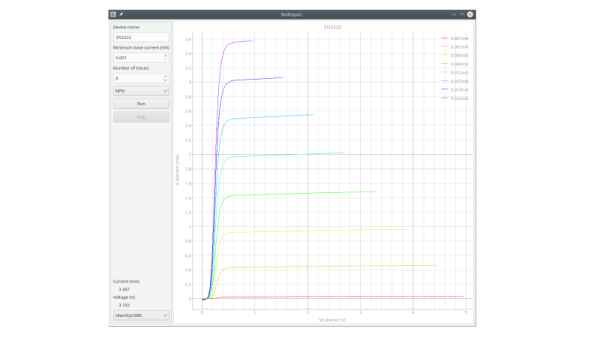
While it works and gives him the IV curves, this simplicity comes at a price. It’s slow — [Joseph] reports that it takes several minutes to trace out five different values of base current on a transistor. It was this lack of speed that inspired him to name the project after cartoon character Speedy Gonzales’s cousin, Slowpoke Rodriguez, AKA “the slowest mouse in all of Mexico”. In addition to being painstakingly slow, the tracer is limited to 5 volts and currents under 5 milliamps.
[Joseph] documents the whole design and build process over on his blog, and has made the source code available on GitHub should you want to try this yourself. We covered another interesting IV curve tracer build on cardboard ten years ago, but that one is much bigger than the Rodriguez.
Read more: RODRIGUEZ — IV CURVE TRACER ON THE CHEAP
-
What components are used to build the Slowpoke Rodriguez IV curve tracer?
The device uses an Arduino Nano and a handful of passive components. -
How does the project improve resolution beyond the standard limits?
It uses the Timer1 library for 1024 PWM steps and implements oversampling on the 10-bit ADC. -
What software controls the IV curve plotting process?
A Python / Qt script generates the desired plots and controls the system. -
Why was the project named after Speedy Gonzales's cousin?
It was named Slowpoke Rodriguez because the tracing process is painfully slow, taking several minutes. -
What are the voltage and current limitations of this tracer?
The tracer is limited to 5 volts and currents under 5 milliamps. -
Where can I find the source code and documentation for this build?
The design is documented on the creator's blog and the source code is available on GitHub. -
Does this project offer faster performance than previous cardboard-based tracers?
No, it is slower, whereas the previous cardboard version was much bigger but implied different trade-offs.
