
Summary of ROBOT SUNFLOWER FOLLOWS THE SUN
This article describes a whimsical DIY project: a plastic sunflower that mimics real plants by tracking the sun. Using an Arduino, light-dependent resistors (LDRs), and a servo motor, the robot adjusts its orientation to maximize light exposure. The author highlights its suitability as an engaging yet accessible school project for children, noting that while microcontrollers are versatile and cheap, a 555 timer circuit could also achieve similar results.
Parts used in the Robo Sunflower:
- Arduino
- Light-dependent resistors (two units)
- Servo motor
- Discrete components (optional alternative)
Real flowers do it, and even the Beatles did it. [Robo Hub] now has a plastic sunflower that tracks the sun using, of course, an Arduino. It may not qualify as a real robot, but it does mimic a real sunflower. The electronics aren’t earth-shattering, of course. An Arduino, a light sensor, and a servo motor are all you really need. But we enjoyed the whimsy and the artistic sensibility. This would be a great school project, for example. Interesting enough to get kids interested but not so hard as to be undoable. You can see a video of the ersatz flower below.
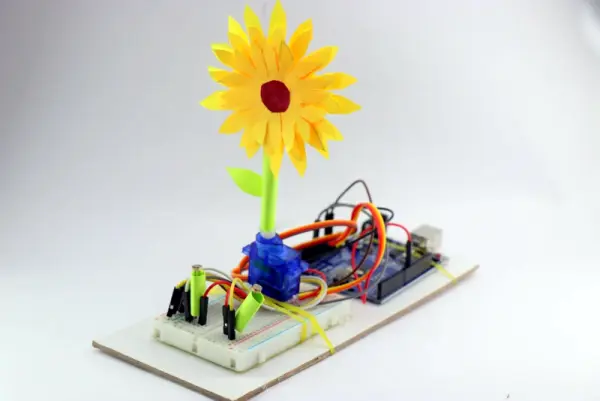
There are actually a pair of light sensors, as you might expect. That way you can determine which sensor is getting the most light. Obviously, these can’t be on-off sensors. They are, in fact, light-dependent resistors, so you get a nice analog reading.
Of course, you might not need an Arduino for this. A 555 driving a servo and a handful of discrete components could measure a bridge with the photoresistors and get the same effect. On the other hand, a microcontroller these days is inexpensive and versatile, so why not?
Usually, people tracking the sun are trying to get more energy. That doesn’t have to be any more complicated, though.
Source: ROBOT SUNFLOWER FOLLOWS THE SUN
- What components are needed to build the sun-tracking flower?
An Arduino, two light sensors, and a servo motor are required. - Can this project be completed without an Arduino?
Yes, a 555 timer driving a servo with discrete components can measure the photoresistors bridge. - How does the flower determine which direction to turn?
It uses two light-dependent resistors to compare analog readings and find the sensor receiving the most light. - Is this project suitable for students?
Yes, it is considered a great school project because it is interesting enough for kids but not too difficult. - What type of sensors are used for light detection?
The project uses light-dependent resistors that provide analog readings rather than simple on-off signals. - Why might someone choose a microcontroller over a 555 timer?
Microcontrollers are inexpensive and versatile compared to other methods.
