
Summary of RENESAS RX66N AND RX72N MCU FAMILIES
Renesas introduces the RX66N and RX72N MCU families, featuring high-speed 120 MHz or 240 MHz CPUs with up to 4 MB Flash and 1 MB SRAM. These chips support advanced applications like AC Servo Drives and HMI panels via dual Ethernet, crypto features, and hardware accelerators including a trigonometric unit and 2D engine.
Parts used in the Renesas RX66N and RX72N Project:
- 32-bit RX MCU
- On-chip Double-precision FPU
- Dual-bank Flash memory
- SRAM
- QSPI interface
- Dual IEEE1588 Ethernet
- SD Host Interface
- Triple CAN interface
- Trigonometric Functions Unit
- LCD Controller
- 2D Engine
- CMOS Camera I/F
- DMACA data transfer channels
- DTC data transfer channel
- EXDMAC channels
- Real-time clock
- Independent watchdog timer
The new Renesas RX66N and RX72N high-performance MCU families offer the highest integration of fast 120 MHz-Flash and SRAM memory and peripheral function
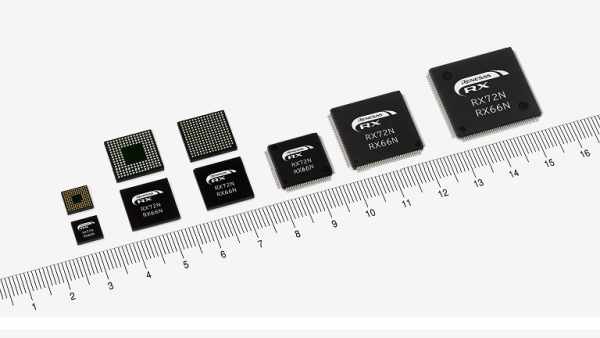
The new Renesas RX66N and RX72N high-performance MCU families offer the highest integration of fast 120 MHz-Flash and SRAM memory and peripheral functions. Up to 4 MB of Flash and 1 MB of SRAM save external memory extensions and enable feature-rich applications like AC Servo Drives and Motion Controllers of HMI Control Panels with TFT LCD. The super high-performance CPU with 120 or 240 MHz delivering up to 1396 CoreMark paired with dual IEEE1588 compliant Ethernet, strongest Crypto features and various HW accelerators matches with demanding needs for future proof and cutting edge designs.
Key Features
- Ultra Performance: 32-bit RX MCU at 240 MHz, On-chip Double-precision FPU, 1396 CoreMark
- Flash Integration: Up to 4-MB Dual-bank Flash, 1 MB SRAM, QSPI
- Rich Connectivity: Dual IEEE1588 Ethernet, SD Host Interface, QSPI and Triple CAN
- Best Peripherals: Trigonometric Functions Unit, LCD Controller, 2D Engine, CMOS Camera I/F
Additional Features
- Arithmetic unit for trigonometric functions supports the highest dynamic motor control
- up to 4-MB flash memory (supportive of the dual bank function)
- 1-MB SRAM, Graphic-LCD Controller, 2D drawing engine
- Data transfer:
- DMACAa: 8 channels, DTCb: 1 channel
- EXDMAC: 2 channels, DMAC for the Ethernet controller: 3 channels
- Real-time clock:
- Adjustment functions (30 seconds, leap year, and error)
- Real-time clock counting and binary counting modes are selectable
- Time capture function (for capturing times in response to event-signal input)
- Independent watchdog timer, 120 kHz clock operation
- Useful functions for IEC60730 compliance:
- Oscillation-stoppage detection, frequency measurement, CRCA, IWDTa, self-diagnostic function for the A/D converter, etc.
- Register write protection function can protect values in important registers against overwriting.
- Various communications interfaces:
Read more: RENESAS RX66N AND RX72N MCU FAMILIES
- What are the key performance specifications of the new MCUs?
The units feature a 32-bit RX CPU running at 120 or 240 MHz with up to 1396 CoreMark. - How much Flash and SRAM memory do these families offer?
They provide up to 4 MB of Dual-bank Flash and 1 MB of SRAM. - Can these MCUs support external memory extensions?
No, the high integration of on-chip memory saves the need for external memory extensions. - Which connectivity options are included in the design?
The devices include dual IEEE1588 Ethernet, SD Host Interface, QSPI, and Triple CAN interfaces. - Does the MCU have hardware acceleration for motor control?
Yes, it includes a Trigonometric Functions Unit to support dynamic motor control. - What graphics capabilities are available on the chip?
The system features a Graphic-LCD Controller and a 2D drawing engine. - How many DMACA channels does the device possess?
The architecture supports 8 channels for DMACA data transfer. - Are there specific functions for IEC60730 compliance?
Yes, it includes oscillation-stoppage detection, frequency measurement, CRCA, and self-diagnostic functions.
