
Summary of Record-breaking 56 gbps receiver circuit for communications between CPUs
Fujitsu Laboratories developed a 56 Gbps receiver circuit, the world's fastest for CPU-to-CPU communication in next-gen servers. By employing a new "look-ahead" architecture that parallelizes signal quality correction processing, the team doubled the circuit's operating frequency. This innovation addresses waveform degradation challenges, supporting the explosive data growth in cloud computing and enabling higher performance for future supercomputers and large-scale server systems.
Parts used in the 56 Gbps Receiver Circuit Project:
- Circuit capable of receiving communications at 56 Gbps
- Look-ahead architecture
- Signal quality correction components
- Next-generation server CPUs
- Optical modules for chassis transmission
Fujitsu Laboratories Ltd. today announced the development of a receiver circuit capable of receiving communications at 56 Gbps. This marks the world’s fastest data communications between CPUs equipped in next-generation servers. In recent years, raising data-processing speeds in servers has meant increasing CPU performance, together with boosting the speed of data communications between chips, such as CPUs. However, one obstacle to this has been improving the performance of the circuits that correct degraded waveforms in incoming signals. Fujitsu Laboratories has used a new “look-ahead” architecture in the circuit that compensates for quality degradation in incoming signals, parallelizing the processing and increasing the operating frequency for the circuit in order to double its speed. This technology holds the promise of increasing the performance of next-generation servers and supercomputers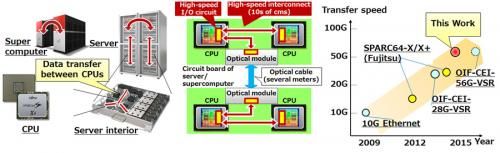 .
.
Details of this technology are being presented at the 2014 Symposia on VLSI Technology and Circuits, opening June 9 in Hawaii (VLSI Circuits Presentation 11-2).
In order to enhance the performance of datacenters underpinning the spread of cloud computing in recent years, a need has arisen for servers that process data faster. While this can be achieved partly through faster CPUs, large-scale systems connecting many CPUs are also being built, and the amount of data transmitted, either within the same CPU-equipped chassis or across separate chassis, is growing dramatically. To cope with these volumes, data communication speeds in the current generation of servers is increasing from a few gigabits per second today to ten or more gigabits per second. Because it is anticipated that data processing volumes will continue to experience explosive growth, however, for the next generation of high-performance servers, the goal is to double current levels to 56 Gbps. Furthermore, the Optical Internetworking Forum (OIF) is moving forward on the standardization of 56 Gbps for the optical modules used for optical transmission between chassis.
For more detail: Record-breaking 56 gbps receiver circuit for communications between CPUs
- What speed does the new receiver circuit support?
The circuit is capable of receiving communications at 56 Gbps. - How did Fujitsu double the circuit speed?
They used a new look-ahead architecture to parallelize processing and increase operating frequency. - Does this technology address waveform degradation issues?
Yes, it compensates for quality degradation in incoming signals which previously hindered performance. - Can this technology be used in supercomputers?
Yes, the technology holds promise for increasing the performance of next-generation supercomputers. - What is the goal for data communication speeds in next-generation servers?
The goal is to double current levels from ten or more gigabits per second to 56 Gbps. - Is 56 Gbps being standardized for optical modules?
Yes, the Optical Internetworking Forum is moving forward on standardizing 56 Gbps for optical modules. - Where were the details of this technology presented?
Details were presented at the 2014 Symposia on VLSI Technology and Circuits in Hawaii.
