
Summary of Researchers Developed Low Cost Battery From Graphite Waste
### Summary Scientists from Empa and ETH Zürich are developing safe, efficient batteries using waste graphite and scrap metal. Led by Kostiantyn Kravchyk and Maksym Kovalenko, the team aims to create power sources from common Earth crust elements like aluminum and graphite. Unlike standard lithium-ion designs where graphite serves as the anode, this new technology uses graphite as the cathode. The system relies on a liquid electrolyte containing special ions that form a non-crystallizing "cold melt" to facilitate ion movement between electrodes.
Parts used in the Waste Graphite Battery:
- Waste graphite
- Scrap metal (such as aluminum)
- Liquid electrolyte with special ions
- Chloride ions
- Large organic anions (as an alternative option)
Lithium-ion batteries are flammable and the price of the raw material is increasing. Scientists and engineers have been trying to find out a safe yet efficient alternative to the Lithium-ion technology. The researchers of Empa and ETH Zürich have discovered promising approaches as to how we might produce powerful batteries out of waste graphite and scrap metal.
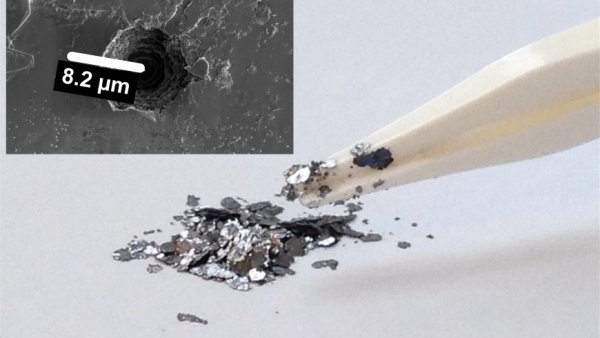
Kostiantyn Kravchyk and Maksym Kovalenko, the two chief researchers of the Empa’s Laboratory for Thin Films and Photovoltaics, led the research group. Their ambitious goal is to make a battery out of the most common elements in the Earth’s crust – such as graphite or aluminum. These metals offer a high degree of safety, even if the anode is made of pure metal. This also enables the assembly of the batteries in a very simple and inexpensive way.
In typical lithium-ion battery design, the negative electrode or anode is made from graphite. This new design, however, uses graphite as the positive electrode or cathode. In order to make such batteries run, the liquid electrolyte needs to consist of special ions that form a kind of melt and do not crystallize at room temperature. The metal ions move back and forth between the cathode and the anode in this “cold melt”, encased in a thick covering of chloride ions.
Alternatively, large but lightweight and metal-free organic anions could be used. But, this raises some questions which cannot be solved easily – where are these “large” ions supposed to go when the battery is charged? What could be a suited cathode material? In comparison, the cathode of the lithium-ion battery is made of a metal oxide which can easily absorb the small lithium cations during charging. This does not work for such large organic ions.
Read more: Researchers Developed Low Cost Battery From Graphite Waste
- Why are researchers looking for alternatives to Lithium-ion batteries?
Lithium-ion batteries are flammable and the price of raw materials is increasing. - Who led the research group at Empa?
The research was led by Kostiantyn Kravchyk and Maksym Kovalenko. - How does the electrode design differ from typical lithium-ion batteries?
This new design uses graphite as the positive electrode or cathode instead of the negative electrode or anode. - What type of electrolyte is required for these batteries to run?
The liquid electrolyte must consist of special ions that form a melt and do not crystallize at room temperature. - How do metal ions move within the battery?
Metal ions move back and forth between the cathode and anode in a cold melt encased in chloride ions. - What challenge arises when using large organic anions?
It is difficult to determine where these large ions go when the battery is charged. - Why can't large organic ions work with the same cathode material as lithium-ion batteries?
The metal oxide cathode used in lithium-ion batteries easily absorbs small lithium cations but cannot accommodate large organic ions.
