
Summary of Plessey’s no-contact heart sensor costs less
Plessey Semiconductors' PS25451 EPIC is an ultra-high-impedance, non-contact solid-state electric potential sensor for proximity, gesture, presence, and medical sensing. It uses active feedback to lower input capacitance and raise input resistance, offering ~20 GΩ input resistance, ~15 pF input capacitance, and a 3 dB bandwidth around 10 kHz. Operable from ±2.4V to ±5.5V, the sensor is cost-reduced with a PCB copper-track electrode covered by protective resist and supplied in a custom surface-mount package, enabling sub-dollar high-volume pricing for consumer applications.
Parts used in the PS25451 Electric Potential Integrated Circuit (EPIC):
- PS25451 EPIC electric potential sensor IC
- Custom surface-mount package with exposed pins
- PCB copper-track electrode covered by protective resist
- Bipolar power supply (±2.4V to ±5.5V)
- Ultra high effective input resistance, typically 20G.
- Effective input capacitance as low as 15pF.
- Upper 3dB point typically 10kHz.
- Operates with bipolar power supply from ±2.4V to ±5.5V.
-
Sensors supplied in a custom package with exposed pins for surface mount assembly.
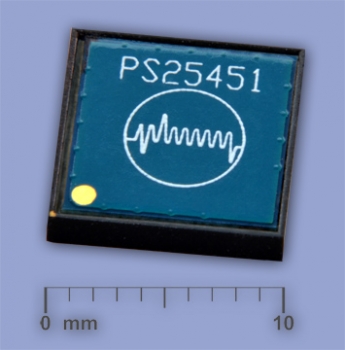
Plessey Semiconductors has said that its EPIC sensor will now sell for less than a dollar in high volume consumer applications.
The company has cost-reduced it electrometer sensing technology with a new electrode design to replace the expensive titanium dioxide electrodes currently used for medical applications.
“The new electrode design for the PS25451 is formed on the copper track of the circuit board that is then covered by the normal protective resist,” said Dr. Keith Strickland, Plessey’s technology director.
The PS25451 device is a non-contact, solid state electric potential sensor that can be used for proximity switching of lighting, gesture-based remote control of interactive toys and presence detection for security/alarm systems.
The EPIC sensor technology works by measuring tiny changes in an electric field in a similar way to a magnetometer detecting changes in a magnetic field even at a distance and through clothing.
A feature of the technique is that it can be used for security motion sensors and non-contact electrical switches as well as medical applications detecting heart beats, nerve and muscle activity either by dry contact (i.e. no gels required) or contactless.
For more read: Plessey’s no-contact heart sensor costs less
- What is the PS25451 used for?
The PS25451 is used as a non-contact electric potential sensor for proximity switching, gesture-based remote control, presence detection, security motion sensors, non-contact electrical switches, and some medical sensing applications. - How does the PS25451 achieve high input resistance and low input capacitance?
The device uses active feedback techniques to lower the effective input capacitance and boost the input resistance. - What are the typical input resistance and input capacitance values?
Typical effective input resistance is 20 GΩ and effective input capacitance can be as low as 15 pF. - What is the frequency response of the sensor?
The upper 3 dB point is typically 10 kHz. - What power supply voltages does the PS25451 operate with?
It operates with a bipolar power supply from ±2.4V to ±5.5V. - How are the sensors supplied for assembly?
Sensors are supplied in a custom package with exposed pins for surface mount assembly. - How did Plessey reduce the cost of the sensor?
Plessey replaced expensive titanium dioxide electrodes with a new electrode design formed on the PCB copper track covered by protective resist. - Can the PS25451 be used for medical sensing without gels?
Yes, it can detect heartbeats, nerve, and muscle activity either by dry contact (no gels required) or contactless, according to the article.
