
Summary of PERFECT CHEESE EVERY TIME WITH THIS TEMPERATURE CONTROLLER
This article describes an Arduino-based temperature controller designed for artisanal cheesemaking vats. The system addresses the critical need for precise thermal management, replacing a failed cheap amplifier with a Sparkfun module to ensure recipe accuracy. While initially tested as a PID controller on a saucepan, the final setup utilizes a simpler bang-bang approach suitable for the vat's high thermal inertia. The project features web monitoring, data logging, and manual program selection, effectively automating the heating process for consistent cheese production.
Parts used in the Cheesemaking Vat Controller:
- Arduino Mega 2650
- K-type thermocouple
- Sparkfun thermocouple amplifier
- Relay
- Ethernet adaptor
- LCD display
- Four buttons
- EEPROM
Anyone who is from a background in which cheesemaking is a feature will tell you that it is an exact science in which small differences in parameters can make a huge difference in the resulting cheese, to the extent that entire batches can be rendered inedible. In particular the temperature at which the milk is held can be crucial to the production of individual styles of cheese. A friend of [William Dudley]’s had this problem, as a dairy farmer and artisinal cheesemaker they had to carefully control their vat with a set of profiles depending upon the recipe in use. This was achieved using an Arduino Mega 2650 and a thermocouple to control the heat source for the hot water in the outer wall of the vat.
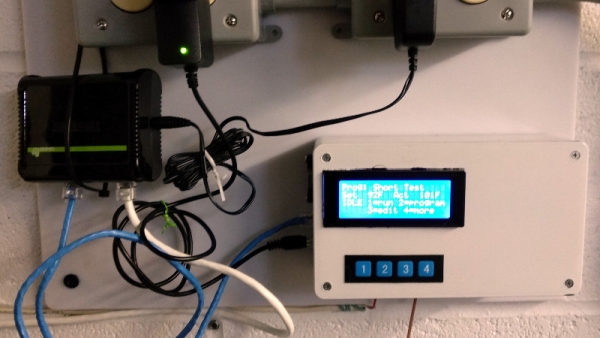
A cheap K-type thermocouple amplifier proved unsatisfactory, so a Sparkfun item was substituted. A relay, Ethernet adaptor, and LCD display provided power control, access to a web interface, and user feedback respectively. Four buttons to select programs were added, and the whole was neatly boxed up to survive the dairy lcd, and put to work. In tests with a saucepan it was configured as a PID controller, but the real vat proved to have a much greater thermal inertia so a simpler bang-bang home thermostat style approach was used. Temperatures are logged in an eeprom for later retrieval via the web interface.
We don’t see the cheeses produced, but we’re sure they must be worth the effort. Blessed may be the cheesemakers, but doubly blessed are they who have a little help from an Arduino.
Source: PERFECT CHEESE EVERY TIME WITH THIS TEMPERATURE CONTROLLER
- Why is temperature control crucial in cheesemaking?
Small differences in parameters like milk temperature can make a huge difference in the resulting cheese or render batches inedible. - What microcontroller was used for this project?
An Arduino Mega 2650 was used to control the heat source for the hot water in the outer wall of the vat. - Which thermocouple amplifier replaced the unsatisfactory cheap option?
A Sparkfun item was substituted after a cheap K-type thermocouple amplifier proved unsatisfactory. - How does the system allow users to interact with it?
It provides access via a web interface and allows users to select programs using four buttons. - What control method was used for the actual vat compared to the saucepan test?
The vat used a simpler bang-bang home thermostat style approach due to its greater thermal inertia, unlike the PID controller used for the saucepan. - Where are the temperature logs stored?
Temperatures are logged in an EEPROM for later retrieval. - Can the temperature data be accessed remotely?
Yes, the logged temperatures can be retrieved via the web interface. - What component provides user feedback in the system?
An LCD display provides user feedback for the system.
