
Summary of PACKING HEAT WITH A HOMEMADE PORTABLE SOLDERING IRON
This article details a DIY portable soldering iron built by [electronoobs], featuring an integrated battery and 3D-printed case. Weighing 100g, it heats up in ten seconds to deliver 15W using a MOSFET and Arduino. While the design includes a display and threaded tip mount, it lacks temperature control due to missing thermocouples. Users must manually remove the battery if undervoltage occurs, though firmware customization is possible.
Parts used in Homemade Portable Soldering Iron:
- Battery
- Small display
- Threaded mount for tips
- Soldering tips
- Arduino
- MOSFET
- Instrumentation for monitoring battery current
- Instrumentation for monitoring tip resistance
- 3D-printed case
Small portable soldering irons are all the rage so [electronoobs] decided to build one on his own. While the design isn’t quite as sleek as a commercial unit, considering it holds its own batteries, it looks pretty good.
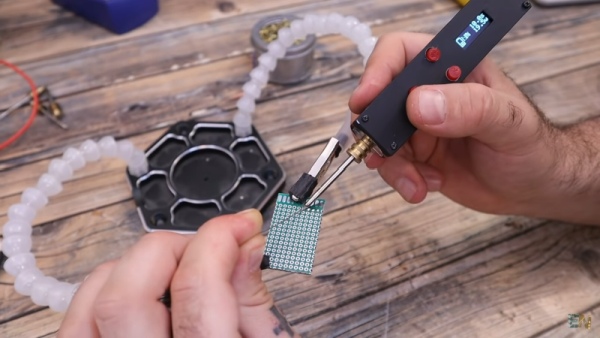
Of course, the question is: does it work? You can see in the video below that it does, melting solder in about ten seconds. The weight is about 100 g, so it should be very comfortable to use.
A small display shows operational parameters. We also liked the threaded mount for the tips. The tips need about 4 A from the battery which results in a 15 W iron. However, the tips don’t have a built-in thermocouple, so you can’t exactly temperature control the tip.
There was a bit of a problem with undervoltage detection, so you do need to be prepared to remove the battery manually if the voltage drops too low. This is somewhat painful, and we might have considered wiring a physical power switch to avoid having to open the 3D-printed case too often.
On the PCB is an Arduino, a MOSFET, and some instrumentation to monitor the battery current and the tip resistance. Naturally, you could do what you like with the firmware to make any number of customizations.
While the iron looks a little like a TS-100, that iron doesn’t contain batteries, so you have to carry an external supply or a battery. But there are commercial irons with batteries. Of course, there have been other similar projects, but we like the looks and expandability of this one.
Source: PACKING HEAT WITH A HOMEMADE PORTABLE SOLDERING IRON
- How fast does the iron heat up?
The iron melts solder in about ten seconds. - What is the weight of the device?
The weight is about 100 grams. - Does the iron have temperature control?
No, the tips do not have a built-in thermocouple for temperature control. - How much power does the iron consume?
The tips draw about 4 A from the battery, resulting in a 15 W iron. - What happens if the battery voltage drops too low?
You need to be prepared to remove the battery manually as there was a problem with undervoltage detection. - Can the firmware be customized?
Yes, you can modify the firmware on the Arduino to make customizations. - What components are on the PCB?
The PCB contains an Arduino, a MOSFET, and instrumentation to monitor battery current and tip resistance. - How does this project compare to the TS-100?
This project contains batteries unlike the TS-100, which requires an external supply or battery.
