
Summary of MURATA’S LTE-M SOLUTION WITH ALTAIR SEMICONDUCTOR’S ADVANCED CELLULAR CHIPSET EARNS DEUTSCHE TELEKOM CERTIFICATION
Murata’s LTE-M Type 1SC module, using Altair Semiconductor’s ALT1250 chipset, earned Deutsche Telekom certification for Germany’s 4G LTE network. Measuring 11.1 x 11.4 x 1.4 mm, the compact, low-power, highly integrated module includes iSIM, an ARM Cortex-M4 MCU, GNSS, and hardware security, enabling long battery life and reduced certification time and cost for IoT devices. It is the first LTE-M module certified by Deutsche Telekom, allowing developers to deploy interoperable mobile IoT products on the carrier’s network.
Parts used in the Type 1SC LTE-M Module Project:
- Murata Type 1SC LTE-M module
- Altair Semiconductor ALT1250 cellular IoT chipset
- Integrated SIM (iSIM)
- ARM Cortex-M4 MCU
- GNSS receiver
- Hardware-based security framework
Murata Electronics today announced that their LTE-M solution powered by Altair Semiconductor’s advanced cellular chipset has secured Deutsche Telekom certification for operating on the carrier’s German 4G LTE wireless network.
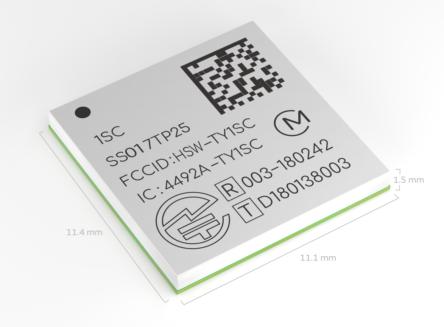
Measuring just 11.1 x 11.4 x 1.4 mm, the module is the world’s smallest form factor solution and enables applications to move the market forward, such as mobile IoT. In addition to its unparalleled size, low power, and cost efficiency, the Type 1SC’s high level of integration drastically cuts time to market and reduces customers’ certification costs.
The module contains Altair’s advanced cellular IoT chipset; the ALT1250 (https://altair-semi.com/products/alt1250/). With an industry-leading low power consumption, it enables IoT devices to run for longer, providing years of operation without the need to replace batteries. Commercially available, the RoHS-compliant chipset features a hardware-based security framework and a rich set of features including integrated SIM (iSIM), an ARM Cortex M4 MCU for the user’s IoT applications and GNSS, ideal for enabling a wide-range of industrial and consumer IoT applications.
Flexible and optimized solutions are the building blocks for realizing IoT on every wireless device. The Type 1SC is the first LTE-M module to be certified by Deutsche Telekom for use on its network. Developers can now leverage the Type 1SC’s confirmed interoperability with the mobile operator’s network to introduce new products and services.
“With the Deutsche Telekom certification, mutual customers can easily tap Murata’s RF expertise and access best-in-class solutions,” said Koichi Sorada, Product Manager Connectivity Modules, Murata Europe.
“Murata is a leading provider of innovative building blocks for the Internet of Things and through our strong partnership we continue to secure superior performance and quality needed for success in mobile IoT,”
Read more: MURATA’S LTE-M SOLUTION WITH ALTAIR SEMICONDUCTOR’S ADVANCED CELLULAR CHIPSET EARNS DEUTSCHE TELEKOM CERTIFICATION
- What certification did the Type 1SC module receive?
It received Deutsche Telekom certification for operating on the carrier’s German 4G LTE network. - How small is the Type 1SC module?
The module measures 11.1 x 11.4 x 1.4 mm. - What chipset does the Type 1SC contain?
It contains Altair Semiconductor’s ALT1250 chipset. - Does the ALT1250 support low power operation?
Yes, the ALT1250 features industry-leading low power consumption enabling long device operation. - What integrated features does the module include?
It includes iSIM, an ARM Cortex-M4 MCU, GNSS, and hardware-based security. - What benefits does the high level of integration provide?
It drastically cuts time to market and reduces customers’ certification costs. - Is the ALT1250 commercially available and compliant?
Yes, the ALT1250 is commercially available and RoHS-compliant. - Can developers rely on network interoperability with Deutsche Telekom?
Yes, Deutsche Telekom certification confirms interoperability for use on its network.
