
Summary of MODULAR ROVER PLATFORM ROLLS ON 3D PRINTED FLEXIBLE TANK TRACKS
James Bruton created a modular rover platform featuring flexible 3D-printed tank tracks made from Ninjaflex filament. The design uses interlocking sections with tabs that fit into drive wheel slots to prevent slipping, mounted on a chassis of 2020 T-slot extrusions. Although currently powered by over-sized 1500 W brushless motors, the system utilizes an Arduino to translate RC signals into differential PWM outputs for precise skid steering control.
Parts used in Modular Rover Platform:
- Ninjaflex filament
- 2020 T-slot extrusions
- Drive wheels
- 1500 W brushless motors
- RC system (receiver and transmitter)
- Arduino microcontroller
- Motor ESCs
Master of 3D printed robots, [James Bruton], plans to do some autonomous rover projects in the future, but first, he needed a modular rover platform. Everything is cooler with tank tracks, so he built a rover with flexible interlocking track sections.
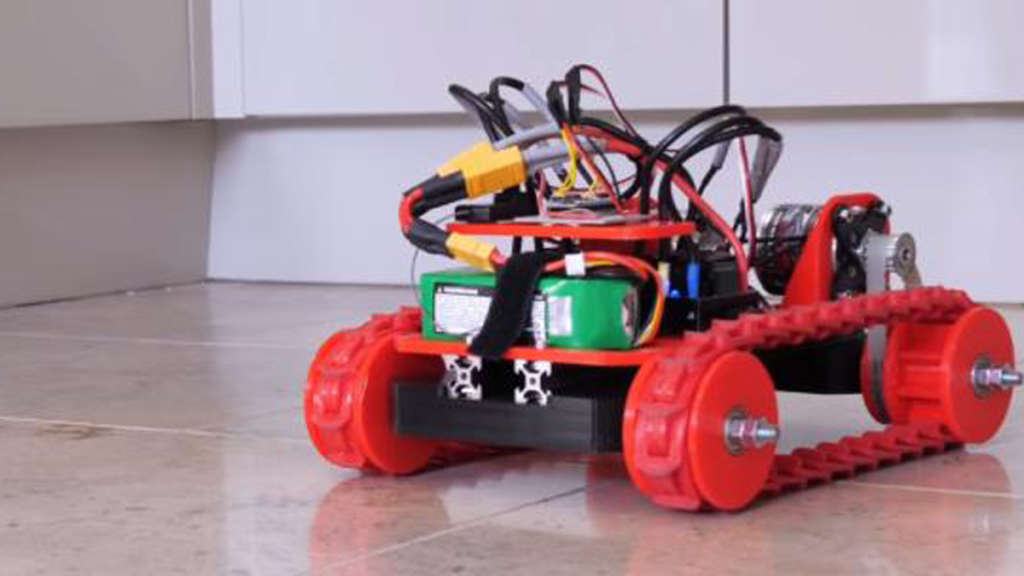
The track sections are printed with flexible Ninjaflex filament. Each section has a tab designed to slot through two neighboring pieces. The ends of the tabs stick through on the inside of the track fit into slots on the drive wheel like gear teeth. This prevents the track from slipping under load. The Ninjaflex is almost too flexible, allowing the tracks to stretch and almost climb off the wheels, so [James] plans to experiment with some other materials in the future. The chassis consists of two 2020 T-slot extrusions, which allows convenient mounting of the wheel bogies and other componeMODULAR ROVER PLATFORM ROLLS ON 3D PRINTED FLEXIBLE TANK TRACKSnts.
For initial driving tests [James] fitted two completely overpowered 1500 W brushless motors that he had on hand, which he plans to replace with smaller geared DC motors at a later stage.
A standard RC system is used for control, but it does not offer a simple way to control a skid steer vehicle. To solve this, [James] added an Arduino between the RC receiver and the motor ESC. It converts the PWM throttle and turn signal from the transmitter, and combines is into differential PWM outputs for the two ESCs.
We look forward to seeing what [James] does with the rover. It seems like the perfect platform for the new Nvidia Jetson Nano 2GB. A while back [rctestflight] built also built an interesting tracker 3D printed rover, which can run autonomously with Ardurover, and sometimes lives out at his flying field.
Source: MODULAR ROVER PLATFORM ROLLS ON 3D PRINTED FLEXIBLE TANK TRACKS
- What material is used for the track sections?
The track sections are printed with flexible Ninjaflex filament. - How does the track prevent slipping under load?
The ends of the tabs stick through on the inside of the track to fit into slots on the drive wheel like gear teeth. - Why might James change the track material?
The Ninjaflex is almost too flexible, allowing the tracks to stretch and almost climb off the wheels. - What material forms the chassis?
The chassis consists of two 2020 T-slot extrusions. - Which motors were used for initial driving tests?
Two completely overpowered 1500 W brushless motors were fitted initially. - How is the skid steer vehicle controlled?
An Arduino converts PWM throttle and turn signals into differential PWM outputs for the two ESCs. - What hardware is suggested as a potential upgrade for autonomy?
The Nvidia Jetson Nano 2GB seems like the perfect platform for future autonomous projects.
