
Summary of milliDelta Robot- High speed and Precision in a Compact Design
Delta robots are high-speed machines with three arms connected to a universal joint, utilizing parallelograms for precise movement in the x, y, and z planes. The milliDelta robot, developed by Harvard's Wyss Institute, is a compact version measuring 15 mm x 15 mm x 20 mm. It employs piezoelectric actuators to achieve speeds up to 75 Hz with 5-micrometer precision. Designed for micro-assembly, microsurgery, and electronics manufacturing, it offers a payload capacity of three times its mass within a 7 cubic millimeter workspace, significantly reducing production time and errors while enabling less invasive medical procedures.
Parts used in the milliDelta Robot:
- Three arms
- Universal join at the base
- Parallelograms
- Piezoelectric actuators
Delta robots are machines with three arms designed to move at high speeds and perform precise tasks. The three arms are connected to a universal join at the base, and the device uses parallelograms that restrict the movement avoiding rotation. As a result, they can move in x, y, and z plane and have high acceleration because it’s made of a light material. They gained popularity in factories for assembly and packaging, so modern devices have been designed to move in more degrees of freedom at accelerations as high as 100 g picking up to 300 items per minute.
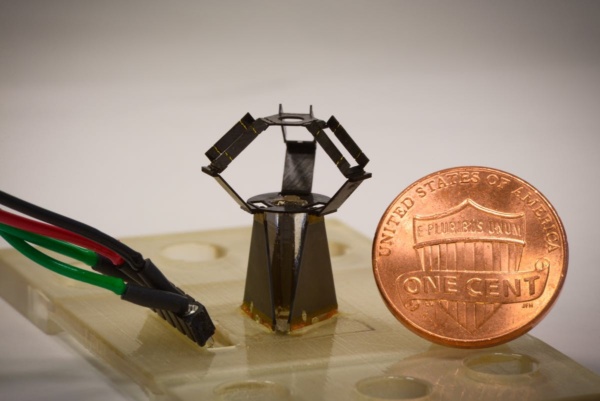
The milliDelta robot designed by Harvard’s Wyss Institute measures 15 mm x 15 mm x 20 mm which makes it lighter. As it weights less, the force needed to move it is smaller causing a huge increase in speed. The device uses piezoelectric actuators that allow the milliDelta to move at up to 75 Hz, and the precision is down to 5 micrometers. The developing team proved that milliDelta can operate in a workspace of about 7 cubic millimeters and has a payload capacity of 3 times its mass which helps optimize spaces in factories where thousands of these devices are used to perform tasks in sequence.
The robot was designed for micro- assembly and microsurgery. Many times, in medical situations speed is a key factor for saving someone´s life, and the milliDelta can achieve speeds that humans cannot. The device is clearly not a replacement for medical professionals, it is a tool to perform faster and more precise procedures. Additionally, the precision could allow for less invasive operations. For electronics manufacturing, the milliDelta is a game changer in time spent a production, and in mistakes made in assembly. This delta robots could be used for 3d printing which for some applications requires micrometer precision, and could reduce printing times significantly.
Read more: milliDelta Robot- High speed and Precision in a Compact Design
- How fast can the milliDelta robot move?
The device uses piezoelectric actuators that allow it to move at up to 75 Hz. - What is the precision of the milliDelta robot?
The precision of the device is down to 5 micrometers. - Can the milliDelta robot be used for microsurgery?
Yes, the robot was designed for micro-assembly and microsurgery to perform faster and more precise procedures. - Does the milliDelta robot reduce printing times?
Yes, these delta robots could be used for 3d printing which requires micrometer precision and could reduce printing times significantly. - What is the payload capacity of the milliDelta robot?
The device has a payload capacity of 3 times its mass. - How does the size of the milliDelta robot affect its speed?
As the robot weighs less due to its small size, the force needed to move it is smaller, causing a huge increase in speed. - What workspace does the milliDelta robot operate in?
The developing team proved that milliDelta can operate in a workspace of about 7 cubic millimeters. - Is the milliDelta robot a replacement for medical professionals?
No, the device is clearly not a replacement for medical professionals but a tool to perform faster and more precise procedures.
