
Summary of Magnetic Stirrer using Arduino
This article provides beta DIY instructions for a battery-operated magnetic stirrer (multiple speed settings) by Malcolm Watts, including notes, a PDF link, and an email Q&A clarifying omitted capacitor specs, wiring versus schematic accuracy, and availability of a circuit board. It explains the stirrer’s use for mixing fluids with minimal contamination and for tasks like overnight dialysis in protein purification.
Parts used in the Magnetic Stirrer:
- Battery (power source)
- Rotating magnet bar (stir bar, placed inside sample)
- Motor or mechanism to create rotating magnetic field
- Multiple speed control (speed setting components)
- Two tantalum capacitors
- One electrolytic capacitor (large electrolytic capacitor, ~1800 pF noted)
- BC557 transistor (or equivalent such as 2N2219 suggested)
- Printed circuit board (optional, available from author)
- Enclosure/box for assembly
- Wiring and connectors
A magnetic stirrer uses a rotating magnetic field to mix fluid samples, such as buffers and media for growing bacteria. Since only a small magnet bar has to be put inside the sample/fluid, the risk of contamination is minimized. For protein purification, overnight sample dialysis steps often utilize magnetic stirrers.
Below are beta release DIY instructions for a magnetic stirrer this summer, courtesy of Malcolm Watts and Massey University in New Zealand. The stirrer runs of off a battery and has multiple speed settings.
You can also download the pdf: magnetic_stirrer_betarelease_V01
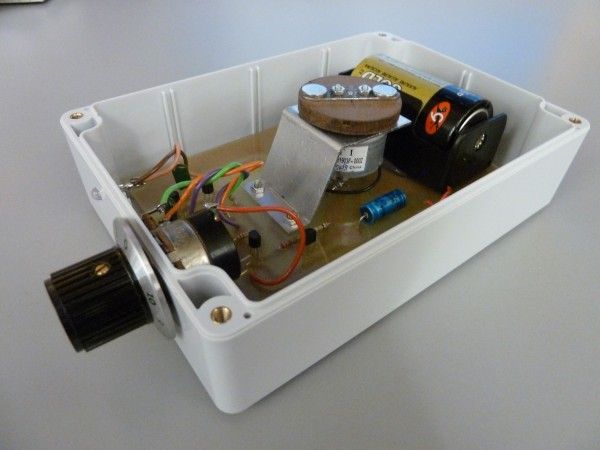
QUESTIONS RECEIVED OVER EMAIL (Clarifications and corrections are added on a rolling basis – a new more dynamic platform to make this easier is under development and will be live in the not too distant future!):
Q: I would very much like to build one of your battery-operated stir bases but you left three critical components out of your instructions. There appear to be two tantalum capacitors and one electrolytic capacitor in the circuit and no specifications are given for any of them. Also, my supplier (Jameco) does not carry a BC557 transistor, I presume a 2N2219 would work as well.
A:
– The large electrolytic capacitor isn’t really required. It’s there to keep the system stable when the battery starts to drain. Any 1.8 nanofarad capacitor that’s close will work. Searching for “CAP 1800PF through hole” or on digikey will give you some good results. I would give you a specific capacitor from Jameco, but I’m not really effective at doing searches in Jameco.
– Also, note that the schematic is more accurate than the wiring diagram which needs to be updated. Follow that first.
– We can also send you a Circuit Board, the one in the document, that will make assembly easier as long as you have a box to put it in. (Note to others: we have a limited supply of these available: email us if you want one sent!)
For more detail: Magnetic Stirrer
- What is the purpose of the large electrolytic capacitor?
It is there to keep the system stable when the battery starts to drain. - Is the large electrolytic capacitor required?
No, it is not really required; any similar capacitor close to 1.8 nanofarad will work. - What capacitance should I look for to replace the electrolytic cap?
The article suggests about 1.8 nanofarad (1800 pF) through-hole capacitors. - Should I follow the wiring diagram or the schematic?
Follow the schematic first, as it is more accurate than the wiring diagram which needs updating. - Can I substitute BC557 with another transistor?
The article indicates a substitute such as 2N2219 is presumed acceptable. - Where can I find suitable capacitors?
Search suppliers or parts listings (example terms given: CAP 1800PF through hole or on digikey) to find suitable capacitors. - Is a circuit board available to simplify assembly?
Yes, the authors can send the circuit board shown in the document, with limited supply; email them to request one. - What are typical uses for this magnetic stirrer?
The article mentions mixing fluid samples like buffers and media and overnight dialysis steps for protein purification.
