
Summary of Machine Design Using Arduino
The team automated a previously assembled machine by creating new motor-driver electronics. Unable to source A3982 drivers, they designed L298-based H-bridge boards in Eagle, assembled through-hole components, tested the switching power supply, and prepared Arduino integration but needed software changes. With the Arduino unusable, they switched to a PIC18F4550-based design using a MAX232 for PC communication and simulated the circuit in Proteus, building a block diagram from that schematic.
Parts used in the H-Bridge Project:
- Arduino Uno
- A3982 stepper motor driver (intended but not available)
- L298 Dual full bridge driver
- H-Bridge Eagle board (PCB design file H-Bridge)
- Through-hole passive components (resistors, capacitors)
- Switching power supply
- Stepper motors
- PIC18F4550 microcontroller
- MAX232 serial interface IC
- Computer for programming and control
The assignment for this week is to automate the machine assembled two weeks ago. For this Roxanna milled the Arduino’s shield for controlling the steppers, but Alejandro found that we haven’t all the components for stuffing, specially the A3982 – stepper motor driver, so as was impossible to get it locally, I decided to design a new one using the L298 (Dual full bridge drive) because it has also the possibility to work with the Arduino Uno at the Fablab.
The Eagle board design file is H-Bridge
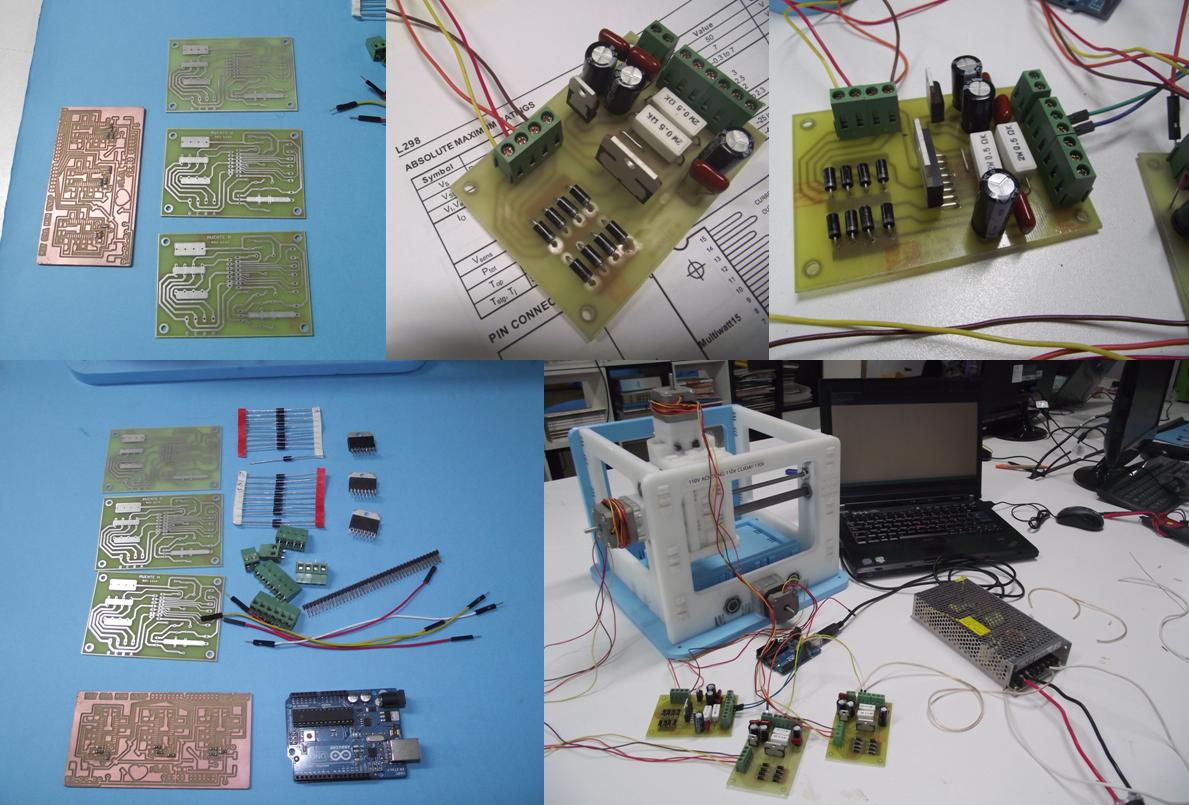
Then we stuffed the boards with through holes, with components got locally. Following we test the Switching PS, and connected to the H- bridge boards, connected the Arduino to the boards and to the computer. I also downloaded and installed all the needed software, and were ready to test; but we have to modify the software for controlling the new boards because they have more connections to the Arduino. The pictures below shows some activities realized, the first one shows the original board and the replacement boards.
At this point we had to leave the machine to the other groups for disassembling and fulfill their assignment. Then I continued with electronics to move the motors.
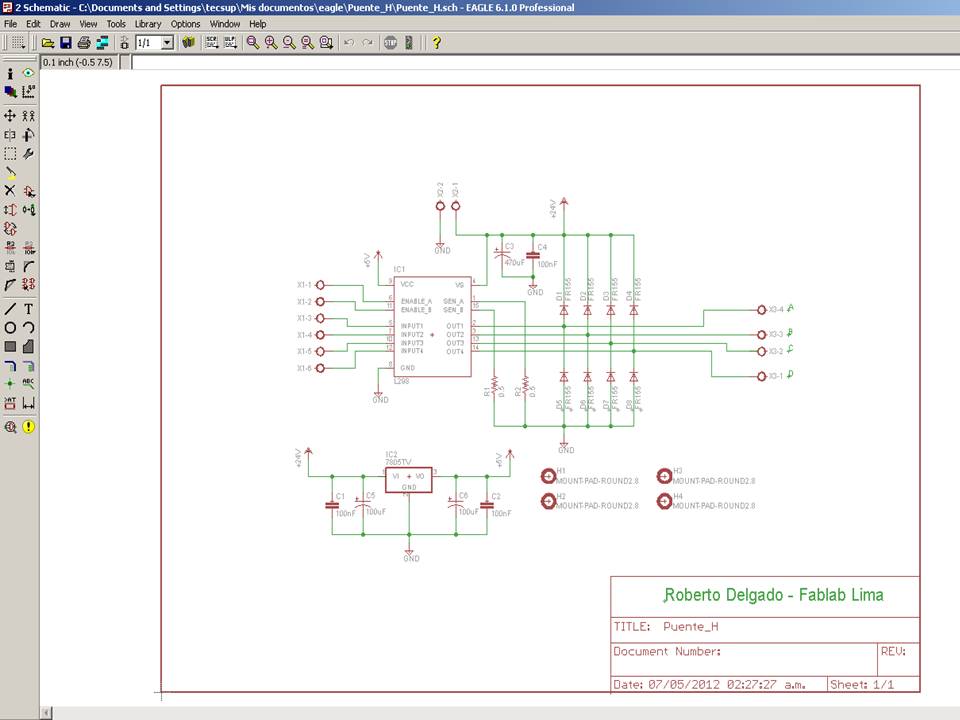
I couldn’t use the Arduino because it was out of order, so I should try another design and worked with a PIC18F4550 microcontroller. I searched the web and found this schematic simulated in Proteus. It uses a Maxim’s Max232 IC for communications with the PC, and 18F series PIC. I build the block diagram from the schematic.
For more detail: Machine Design Using Arduino
- Why was a new driver design created for the machine?
A3982 stepper motor drivers were not available locally, so a new design using the L298 was created. - What driver IC was used as a replacement for the A3982?
The L298 Dual full bridge driver was used as the replacement. - How were the H-bridge boards fabricated?
The Eagle board design file named H-Bridge was used, and boards were stuffed with through-hole components obtained locally. - Was the switching power supply tested?
Yes, the switching power supply was tested and connected to the H-bridge boards. - Why did the team need to modify the software?
The new L298-based boards have more connections to the Arduino, requiring software modifications to control them. - What did the team do when the Arduino became unusable?
They switched to a PIC18F4550 microcontroller design and used a MAX232 for PC communication. - How was the PIC-based design developed or verified?
A schematic using the PIC18F4550 and MAX232 was found and simulated in Proteus, and a block diagram was built from that schematic. - Did the team complete motor movement testing?
The author continued with electronics to move the motors after other groups disassembled the machine, but the Arduino was out of order so PIC-based work proceeded.
