
Summary of LTC6268-10 – 4GHz Ultra-Low Bias Current FET Input Op Amp
The LTC6268-10 and LTC6269-10 are ultra-low bias current FET-input operational amplifiers featuring a 4GHz gain-bandwidth product and rail-to-rail output. Designed for high-speed transimpedance and sensor applications, they operate between 3.1V and 5.25V with a shutdown feature for power saving. The single op amp (LTC6268-10) comes in SOIC-8 and TSOT-23-6 packages, while the dual version (LTC6269-10) is available in MSOP-8 and DFN-10 packages, supporting temperatures from –40°C to 125°C.
Parts used in LTC6268-10/LTC6269-10 Project:
- LTC6268-10 Single Op Amp
- LTC6269-10 Dual Op Amp
- 8-Lead SOIC Package
- 6-Lead TSOT-23 Package
- 8-Lead MSOP Package
- 10-Lead DFN Package
- Input Pin Guard Ring
Features
- Gain Bandwidth Product: 4GHz
- Low Input Bias Current:
- ±3fA Typ. Room Temperature
- 4pA Max at 125°C
- Current Noise (100kHz): 7fA/√Hz
- Voltage Noise (1MHz): 4.0nV/√Hz
- Extremely Low CIN 0.45pF
- Rail-to-Rail Output
- AV ≥10
- Slew Rate: +1500V/μs, –1000V/μs
- Supply Range: 3.1V to 5.25V
- Quiescent Current: 16.5mA
- Operating Temp Range: –40°C to 125°C
- Single in 8-Lead SO-8, 6-Lead TSOT-23 Packages
- Dual in 8-Lead MS8, 3mm × 3mm 10-Lead DFN 10 Packages
Description
The LTC®6268-10/LTC6269-10 is a single/dual 4GHz FET-input operational amplifier with extremely low input bias current and low input capacitance. It also features low input-referred current noise and voltage noise making it an ideal choice for high speed transimpedance amplifiers, and high-impedance sensor amplifiers. It is a decompensated op amp that is gain-of-10 stable.
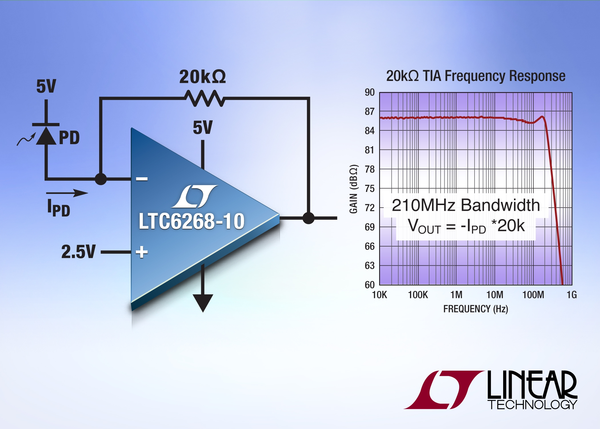
It operates on 3.1V to 5.25V supply and consumes 16.5mA per amplifier. A shutdown feature can be used to lower power consumption when the amplifier is not in use.
The LTC6268-10 single op amp is available in 8-lead SOIC and 6-lead SOT-23 packages. The SOIC package includes two unconnected pins which can be used to create an input pin guard ring to protect against board leakage currents. The LTC6269-10 dual op amp is available in 8-lead MSOP with exposed pad and 3mm × 3mm 10-lead DFN packages. They are fully specified over the –40°C to 85°C and the –40°C to 125°C temperature ranges.
Applications
- Transimpedance Amplifiers
- ADC Drivers
- Photomultiplier Tube Post-Amplifier
- Low IBIAS Circuits
For more Details: LTC6268-10 – 4GHz Ultra-Low Bias Current FET Input Op Amp
-
What is the Gain Bandwidth Product of these amplifiers?
The Gain Bandwidth Product is 4GHz. -
Can the amplifier be used in low input bias current circuits?
Yes, it features extremely low input bias current making it ideal for such applications. -
Does the device support rail-to-rail output?
Yes, it features Rail-to-Rail Output at AV ≥10. -
What supply voltage range does the LTC6268-10/LTC6269-10 operate on?
It operates on a supply range of 3.1V to 5.25V. -
How can power consumption be lowered when the amplifier is not in use?
A shutdown feature can be used to lower power consumption. -
What packages are available for the single op amp version?
The single op amp is available in 8-lead SOIC and 6-lead TSOT-23 packages. -
What is the maximum operating temperature range?
The operating temperature range extends up to 125°C. -
Is this op amp stable at a gain of 1?
No, it is a decompensated op amp that is gain-of-10 stable.
