
Summary of LTC Design Note: Inverting DC/DC controller converts a positive input to a negative output with a single inductor
Summary: The LTC3863 is a single-inductor inverting DC/DC controller that generates –0.4V to –150V from a 3.5V–60V input using one P-channel MOSFET and one diode. It offers high light-load efficiency (70μA in Burst Mode), programmable switching (50–850kHz), sync capability, programmable soft-start/tracking, and protections including overvoltage, overcurrent, short-circuit with frequency foldback. Example: a –5.2V, 1.7A converter from 4.5V–16V input using flyback-like energy transfer without a transformer.
Parts used in the LTC3863 Inverting DC/DC Controller Project:
- LTC3863 controller IC
- P-channel MOSFET (active switch)
- Diode (output diode)
- Inductor (single inductor energy storage)
- Input voltage source (3.5V to 60V range; example 4.5V–16V)
- Output capacitor(s) (for negative output filtering)
- Resistor for programming switching frequency
- External clock source (optional for synchronization, 75kHz–750kHz)
- Soft-start/tracking components (programming resistors/capacitors)
- Protection sensing components (current sense resistor or circuitry as required)
There are several ways to produce a negative voltage from a positive voltage source, including using a transformer or two inductors and/or multiple switches. However, none are as easy as using the LTC3863, which is elegant in its simplicity, has superior efficiency at light loads and reduces parts count compared to alternative solutions.
Advanced Controller Capabilities
The LTC3863 can produce a –0.4V to –150V negative output voltage from a positive input range of 3.5V to 60V. It uses a single-inductor topology with one active P-channel MOSFET switch and one diode. The high level of integration yields a simple, low parts-count solution.
The LTC3863 offers excellent light load efficiency, drawing only 70μA quiescent current in user-programmable Burst Mode operation. Its peak current mode, constant frequency PWM architecture provides positive control of inductor current, easy loop compensation and superior loop dynamics. The switching frequency can be programmed from 50kHz to 850kHz with an external resistor and can be synchronized to an external clock from 75kHz to 750kHz. The LTC3863 offers programmable soft-start or output tracking.
Safety features include overvoltage, overcurrent and short-circuit protection, including frequency foldback.
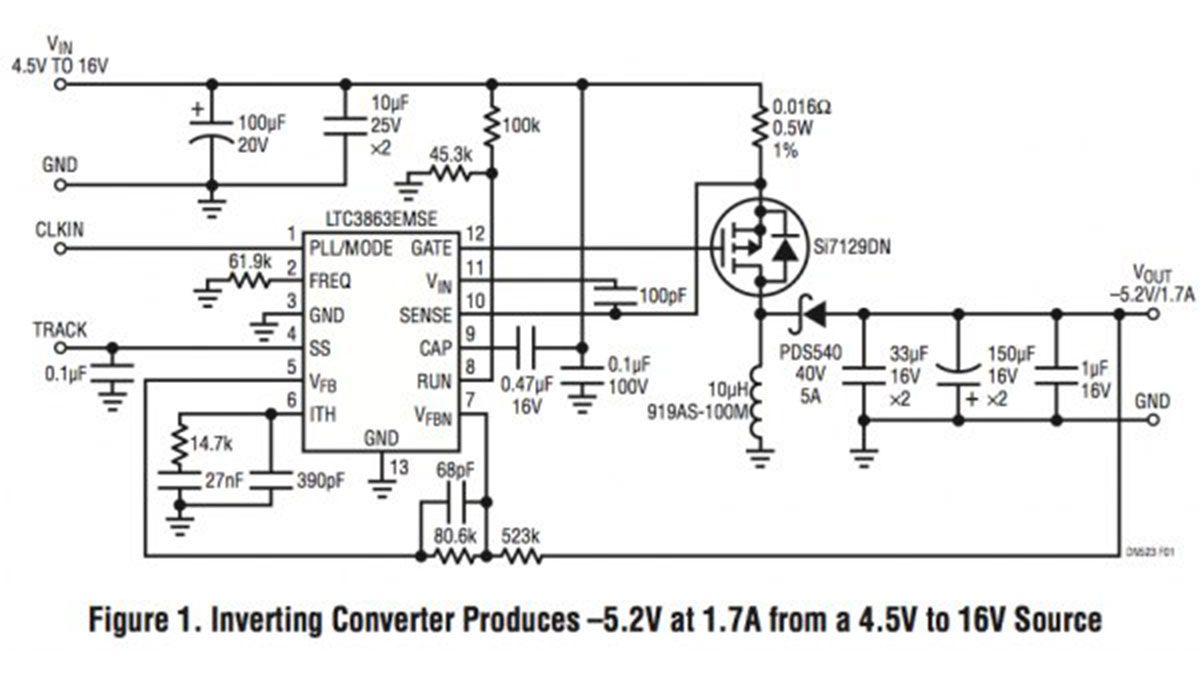
–5.2V, 1.7A Converter Operates from a 4.5V to 16V Source
The circuit shown in Figure 1 produces a –5.2V, 1.7A output from a 4.5V–16V input. Operation is similar to a flyback converter, storing energy in the inductor when the switch is on and releasing it through the diode to the output when the switch is off, except that with the LTC3863, no transformer is required. To prevent excessive current that can result from minimum on-time when the output is short-circuited, the controller folds back the switching frequency when the output is less than half of nominal.
FOr More Details: LTC Design Note: Inverting DC/DC controller converts a positive input to a negative output with a single inductor
- What negative output range can the LTC3863 produce?
The LTC3863 can produce a negative output from –0.4V to –150V as stated in the article. - What input voltage range does the LTC3863 accept?
The LTC3863 accepts a positive input range of 3.5V to 60V according to the article. - How many inductors and switches does the LTC3863 topology require?
It uses a single inductor topology with one active P-channel MOSFET switch and one diode. - How efficient is the LTC3863 at light loads?
In user-programmable Burst Mode operation it draws only 70 microamperes quiescent current, indicating excellent light-load efficiency. - What switching frequency range can be programmed for the LTC3863?
The switching frequency can be programmed from 50kHz to 850kHz with an external resistor. - Can the LTC3863 synchronize to an external clock?
Yes, it can synchronize to an external clock from 75kHz to 750kHz. - What protections does the LTC3863 provide?
It provides overvoltage, overcurrent and short-circuit protection, including frequency foldback. - What is an example application and its performance described in the article?
The article shows a circuit producing –5.2V at 1.7A from a 4.5V–16V input using the LTC3863. - Does the LTC3863 require a transformer like a flyback converter?
No, it operates similarly to a flyback but requires no transformer, using a single inductor instead. - How does the controller prevent excessive current during a short circuit?
The controller folds back the switching frequency when the output is less than half of nominal to prevent excessive current from minimum on-time.
