
Summary of LIQUID FLOW SENSORS OFFER HIGH-ACCURACY, LOW-MAINTENANCE REPLACEMENT FOR MECHANICAL TURBINE DEVICES
Posifa Technologies’ PLF2000 series are cost-effective MEMS thermal liquid flow sensors replacing mechanical turbines, offering higher accuracy and reliability in unstable pulsatile and low-flow conditions. Factory-calibrated for water to 5% minimum (typical 3%) volume accuracy, they feature dual I2C and analog outputs, a solid-state third-generation thermal flow die with thermopiles, fast 5 ms response, 0.5% F.S. repeatability, minimal flow obstruction, and operation from +5 °C to +75 °C. Suitable for coffee machines, water dispensers, vending, cleaning systems, and liquid cooling, and compliant with NSF/ANSI 61.
Parts used in the PLF2000 series:
- PLF2000 series sensor package
- Third-generation thermal flow die with thermopiles
- Solid-state thermal isolation structure
- Dual digital I2C interface
- Analog voltage output
- Factory calibration for water
- Sensor housing suitable for liquid flow path
Cost-Effective MEMS Sensors Deliver Increased Performance and Reliability, Even in Unstable Pulsatile Flow and Low-Flow Conditions
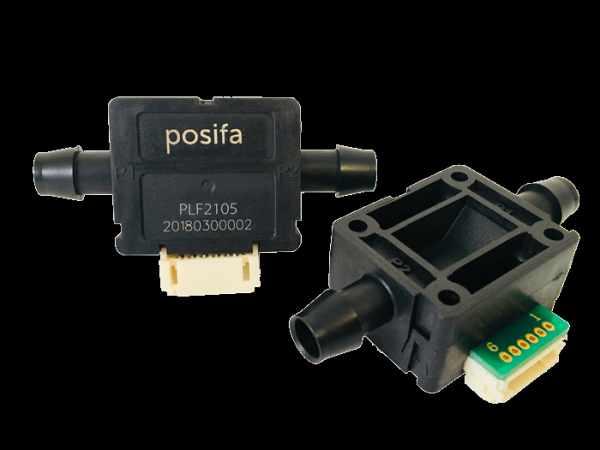
Posifa Technologies introduced its new PLF2000 series of liquid flow sensors. Designed to replace mechanical turbine flow sensors, the cost-effective devices deliver increased accuracy and reliability, even in unstable pulsatile flow and low-flow conditions. Factory calibrated for water to a minimum 5 % and typical 3 % accuracy for volume calculation, the PLF2000 series’ dual digital I²C and voltage output provides high performance, flexibility, and scalability in a compact package.
The PLF2000 series features Posifa’s third-generation thermal flow die, which uses a pair of thermopiles to detect changes in temperature gradient caused by mass flow. The result is an excellent signal-to-noise ratio and repeatability of 0.5 % F.S. The solid-state thermal isolation structure on the sensor die eliminates the need for a surface cavity or fragile membrane used in competing technologies, allowing it to be placed directly in the liquid flow path with minimal packaging for higher sensitivity. In addition, the sensor die does not obstruct the flow path, allowing for minimal flow resistance and making it possible to circulate liquid via gravity, a boiler, or a low-power pump. With no moving parts, the sensor does not get stuck, suffer mechanical breakdowns, or require disassembly for cleaning and maintenance.
Key Specifications And Benefits:
- Dual digital I2C and analog output
- Compact, robust package
- Solid-state sensing core – no moving parts
- Feature Posifa’s third-generation thermal flow die
- Measure flow rates up to 0.7 l/min (PLF2105) and 10 l/min (PLF2135)
- Extremely fast response times of 5 ms typical
- Excellent signal-to-noise ratio and repeatability of 0.5 % F.S.
- Operating temperature range of +5 °C to +75 °C
- Comply with NSF/ANSI 61: Drinking Water System Components — Health Effects
Target Applications:
- Coffee and espresso machines
- Water dispensers, purifiers, and filtration systems
- Beverage vending machines
- Detergent vending machines
- Cleaning chemical mixing systems
- Liquid cooling systems
Read more: LIQUID FLOW SENSORS OFFER HIGH-ACCURACY, LOW-MAINTENANCE REPLACEMENT FOR MECHANICAL TURBINE DEVICES
- What type of output does the PLF2000 series provide?
The PLF2000 series provides dual digital I2C and analog voltage output. - Can the PLF2000 sensors measure low and pulsatile flows accurately?
Yes, they deliver increased accuracy and reliability even in unstable pulsatile flow and low-flow conditions. - What is the factory calibration accuracy for volume calculation?
They are factory calibrated for water to a minimum 5% and typical 3% accuracy for volume calculation. - Do the sensors have moving parts that require maintenance?
No, the PLF2000 series uses a solid-state sensing core with no moving parts, so it does not get stuck or require disassembly for cleaning and maintenance. - What flow rate ranges do the PLF2000 models cover?
They measure flow rates up to 0.7 l/min for the PLF2105 and up to 10 l/min for the PLF2135. - How fast is the sensor response time?
The sensors have extremely fast response times of 5 ms typical. - What is the repeatability performance of the sensors?
They offer repeatability of 0.5% full scale (F.S.). - What operating temperature range do the sensors support?
The operating temperature range is +5 °C to +75 °C. - Are the sensors safe for drinking water applications?
Yes, they comply with NSF/ANSI 61: Drinking Water System Components — Health Effects. - What applications are targeted for the PLF2000 series?
Target applications include coffee and espresso machines, water dispensers and purifiers, beverage and detergent vending machines, cleaning chemical mixing systems, and liquid cooling systems.
